
- Industries
- Commercial Property ManagementParking lots, lobbies and common areas protected day and night.
- ConstructionJob site theft and after-hours break-ins, covered until the crew returns.
- Logistics and WarehouseGates, yards and loaded trailers watched and logged around the clock.
- AutomotiveLots, keys and inventory protected while the dealership is closed.
- EducationCampuses, doors and after-hours events kept safe.
- Health Care FacilityVisitor screening, patrols and monitoring for healthcare buildings.
- Services
- Security Guards & PatrolLicensed officers at the gate or on mobile patrol, with GPS-verified logs.
- Drone & RoboticsAerial and robotic patrols for large or hard-to-reach sites.
- Security TrailersMobile surveillance units that can be deployed within hours.
- Security CamerasCamera systems built to detect and report, not just record.
- Video MonitoringAI flags it, a human verifies it, and dispatch follows. 24/7.
- NotaryNotary public services for your business.
- Live ScanLive Scan fingerprinting for background checks.
- Resources
- About us
- Careers
Security for Healthcare Facilities in Sacramento
Author
Pranil Shankar
Post Date
June 12, 2026
Views
266
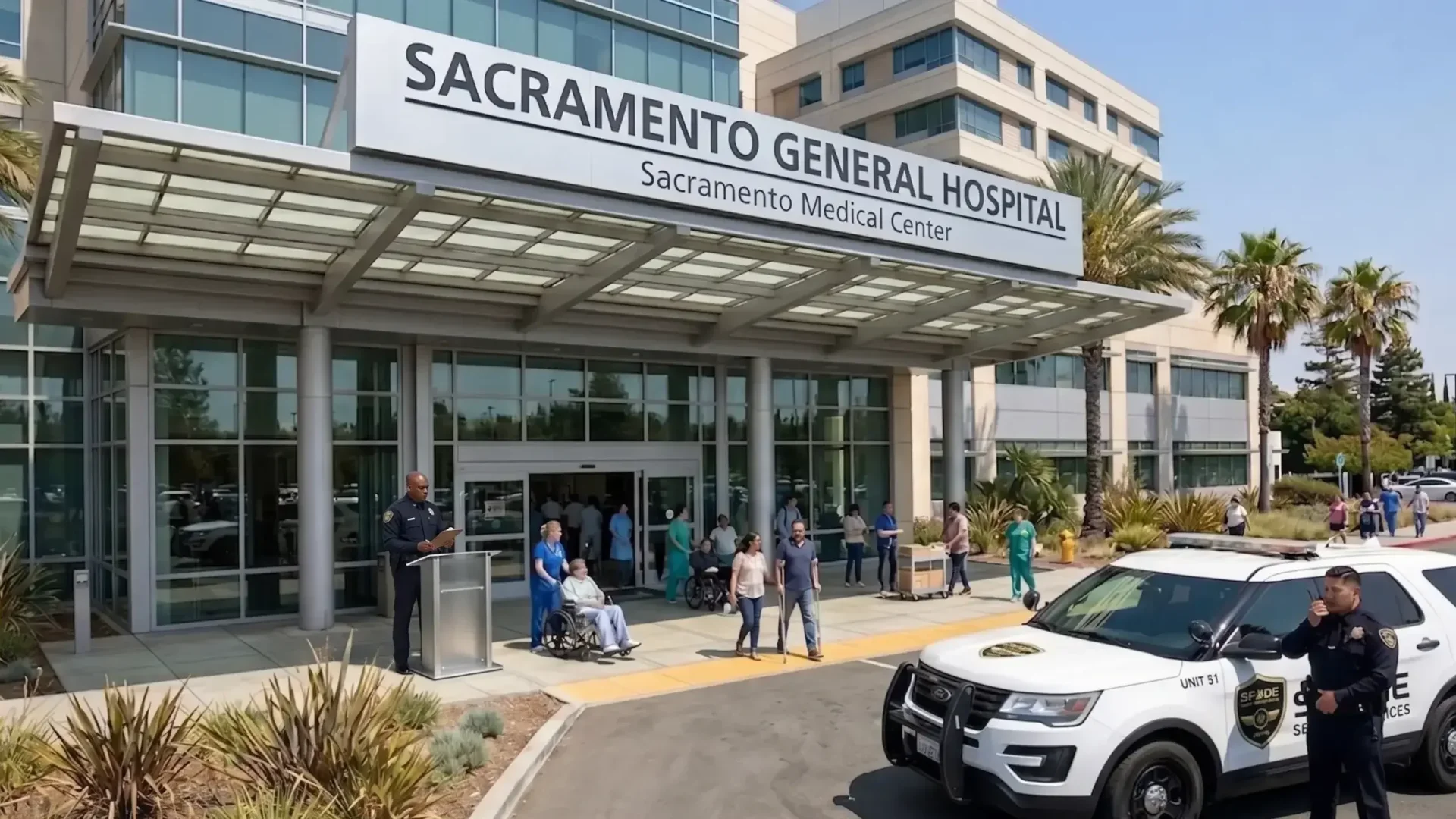
Sacramento Healthcare Facilities Are Running Out of Ways to Protect Staff Without Restricting Patients. SPADE Is the Security Program That Does Both.
Healthcare facilities are among the most security-complex environments in any community. You have patients in vulnerable conditions, staff working extended shifts in high-stress environments, controlled substances on-site, and a public access requirement that means you cannot simply lock the doors when things get difficult. And when they do get difficult — when an agitated patient escalates, when a domestic situation follows someone into your waiting room, when a trespasser refuses to leave — the people you need on the floor in that moment are nurses and physicians, not security responders.
That gap — between the public access requirements of healthcare and the safety requirements of the people inside — is where professional security programs for Sacramento healthcare facilities are built.
In 2026, healthcare security in the Sacramento region is increasingly viewed not as a discretionary cost but as a patient safety and staff retention component of operations. Facilities that do not address the security gap are experiencing the downstream consequences: staff injuries, regulatory scrutiny, increased workers’ compensation costs, and a staff safety culture that affects both recruitment and retention in one of the tightest healthcare labor markets in California history.
Why Sacramento Healthcare Facilities Are at Elevated Security Risk in 2026
Healthcare facilities present a specific risk profile that general commercial security programs are not designed to address.
Patient population vulnerability creates both safety obligations and behavioral risk. Patients in distress, patients managing mental health crises, patients affected by substance use, and patients with companions who are managing their own stress all create an elevated behavioral risk environment in waiting rooms, emergency areas, and common spaces that general commercial security protocols do not anticipate.
Staff isolation during extended shifts creates specific exposure. Healthcare staff — nurses, medical assistants, front desk personnel — frequently work in areas with limited colleague proximity during evening and night shifts. Situations that escalate in a single-staff area of a clinic or hospital unit can develop significantly before additional personnel are available.
Controlled substance presence is a persistent security driver for medical facilities of all sizes. From the pharmacy dispensary in a hospital system to the medication cabinet in a primary care clinic, controlled substance storage creates theft risk and intrusion motivation that requires a security response calibrated specifically to healthcare environments.
Parking structure and lot access during evening and overnight hours affects staff safety in ways that broader patient safety discussions sometimes overlook. Healthcare staff leaving late shifts face the same parking lot vulnerabilities as any other commercial property — but in a context where they may be fatigued, may be walking alone at 2 a.m., and may be in a campus environment where security coverage is concentrated inside the building rather than in the approach to their vehicle.
What California Requires of Healthcare Facilities on Workplace Security
California has specific workplace violence prevention requirements for healthcare facilities that go beyond general employer obligations.
California Code of Regulations Title 8, Section 3342 — the Healthcare Workplace Violence Prevention Standard — requires healthcare employers to develop, implement, and maintain a written workplace violence prevention plan specific to each facility. That plan must include a workplace violence hazard assessment, prevention strategies, incident response protocols, and a training program for all clinical and non-clinical staff.
The standard defines four types of workplace violence — Type I (criminal intent), Type II (patient or client), Type III (worker-on-worker), and Type IV (personal relationship) — and requires that the prevention plan address each type with facility-specific strategies.
A licensed security provider that understands healthcare-specific violence prevention requirements is a key component of compliance for Sacramento-area facilities. The security company’s documentation — incident reports, patrol logs, training records — directly supports the facility’s compliance record under the Cal/OSHA healthcare standard and under the Joint Commission standards for those facilities subject to accreditation.
What Security Services Are Most Effective for Sacramento Healthcare Facilities
Security programs for healthcare facilities in the Sacramento region are most effective when they are designed around the specific environment of healthcare — not adapted from retail or commercial templates.
Uniformed security officer coverage during high-risk periods. Emergency department waiting rooms, behavioral health units, and high-activity lobby areas benefit from uniformed security presence during the periods of highest patient volume and highest behavioral risk — typically weekday evenings and weekend hours when patient acuity is highest and staffing is thinnest. A security officer who can de-escalate a situation before it becomes a staff injury is the primary ROI of clinical area coverage.
After-hours lobby and entry control. After business hours, controlling building access through a security-managed entry point protects both staff working late shifts and patients in overnight care. After-hours access control by a professional security officer is a fundamentally different service than an automated lock system — it provides human judgment, de-escalation capability, and documented access logs.
Parking structure and lot escort service for staff. Staff safety programs at Sacramento healthcare facilities increasingly include parking escort service for staff working evening and night shifts. A security officer who escorts staff to their vehicles during vulnerable overnight hours is a direct staff safety investment — and one that healthcare facilities in the Sacramento region increasingly communicate as a recruitment and retention benefit in a competitive labor market.
Rapid response and incident documentation. When an incident occurs in a healthcare environment — a patient altercation, a trespasser, a domestic situation involving a patient or visitor — the documentation that follows is regulatory, not just operational. Incident reports from a licensed security provider formatted to meet Cal/OSHA and Joint Commission documentation requirements create the compliance record that a facility’s risk management team needs.
The Cost of the Wrong Security Program in a Sacramento Healthcare Facility
The security company that wins your contract on price is not the security company that prevents the incident that price was supposed to avoid. A security officer who has not been trained in healthcare-specific de-escalation is not a patient safety asset — he is a liability in scrubs. A patrol log that does not meet Cal/OSHA documentation standards is not compliance support — it is evidence that your facility failed to meet the standard when a claim is filed.
At SPADE, every officer deployed to a Sacramento healthcare facility is:
- Hired directly by SPADE — no subcontractors, no staffing agencies
- Trained to SPADE’s operational standards — including healthcare-specific de-escalation and patient interaction protocols
- Briefed specifically on your facility before their first shift — not given a generic orientation and sent in
- Managed directly by SPADE leadership — with no intermediary in the accountability chain
- Generating documentation formatted to meet Cal/OSHA and Joint Commission requirements from day one
When something happens on your Sacramento healthcare property, the people responsible for the outcome are the same people who sold you the program. There is no agency to redirect the conversation to. There is only SPADE — and the accountability that comes with owning every deployment we run.
Why Sacramento Healthcare Facilities Choose SPADE Security Services
SPADE Security Services is a veteran-owned, DVBE-certified physical security company headquartered in Rocklin, California. We provide security programs for healthcare facilities across Sacramento County and Placer County — including medical office buildings, outpatient clinics, urgent care facilities, and medical campus environments.
Our healthcare security programs are designed around the specific risk profile of clinical environments — patient population dynamics, staff safety requirements, controlled substance access protocols, and the Cal/OSHA healthcare workplace violence prevention requirements that govern documentation and training for California healthcare facilities.
We offer a complimentary facility security assessment for healthcare operations in the Sacramento region. We walk your facility, review your current security posture against Cal/OSHA healthcare requirements, and give you a written security program recommendation your administration and risk management teams can act on directly.
Veteran-owned. Locally operated. PPO121804. Founded by a U.S. Marine Corps combat veteran. Licensed by the California Bureau of Security and Investigative Services. Headquartered in Rocklin and serving Placer, Sacramento, and El Dorado counties.
Get a Free Healthcare Security Assessment in Sacramento
Every week without a professional security program is a week your Sacramento healthcare facility is exposed to the specific threats that are active in this market right now. We walk your facility, identify your specific security requirements, and give you a written recommendation with associated costs — at no cost and no obligation. No generic proposal. A specific assessment of your specific facility by a security company that operates in this region every day.
For publicly funded healthcare facilities, we provide the DVBE procurement documentation your purchasing team needs alongside your security assessment.
SPADE Security Services
Rocklin, CA — Serving Sacramento County and Placer County healthcare facilities
Veteran-owned | DVBE certified | Licensed by the California Bureau of Security and Investigative Services
Get Your Free Healthcare Security Assessment
Frequently Asked Questions
What does California’s healthcare workplace violence prevention standard require of medical facilities in Sacramento?
California Code of Regulations Title 8, Section 3342 requires healthcare employers to develop and implement a written workplace violence prevention plan that includes a hazard assessment specific to each facility, prevention and mitigation strategies for all four types of workplace violence, an incident response protocol, and a training program for all facility staff. The plan must be reviewed and updated annually and following any serious incident. A licensed security provider with healthcare-specific experience contributes to compliance by providing documented security activity, incident reports in required formats, and staff training components that support the facility’s workplace violence prevention program.
How do Sacramento healthcare facilities manage security without restricting patient access?
Patient access requirements in healthcare environments require security approaches that manage behavioral risk without creating access barriers that deter patients seeking care. The most effective approaches focus security resources on the areas of highest behavioral risk — emergency waiting rooms, behavioral health units, pharmacy access points — rather than applying blanket access restriction at primary entry points. Uniformed security presence in high-risk areas combined with after-hours controlled access at secondary entry points creates a security program that addresses staff and patient safety without affecting care access during operating hours.
What is the ROI of security staff in a Sacramento medical clinic or urgent care facility?
The primary ROI of security in a healthcare setting is staff safety and retention. A single staff injury incident — resulting in a workers’ compensation claim, a Cal/OSHA recordable, and a staff member who does not return — costs more than a year of security staffing for most clinic environments. Beyond injury cost, staff safety culture affects recruitment and retention in a healthcare labor market where compensation alone is rarely sufficient differentiation. Facilities that can document and communicate a serious staff safety program — including professional security coverage — gain a meaningful recruiting advantage in the Sacramento market.
Can SPADE Security Services provide security for a Sacramento medical office building with multiple tenant practices?
Yes. SPADE provides security programs for medical office buildings with multiple tenant practices across Sacramento County and Placer County. For multi-tenant medical facilities, we develop coverage plans that address shared common areas, parking structures, and after-hours entry control alongside tenant-specific requirements for practices with extended hours or elevated security needs. Incident reporting is formatted to serve both building management and individual tenant practices. Contact us to discuss your specific building configuration.
Is SPADE Security Services qualified to provide security for publicly funded healthcare facilities in Sacramento County?
Yes. SPADE Security Services holds DVBE certification through the California Department of General Services, qualifying us for state and local government procurement programs. Publicly funded healthcare facilities — including county-operated clinics, community health centers receiving state or federal funding, and health system facilities subject to public agency procurement rules — can count SPADE toward DVBE participation goals. Contact us to discuss your procurement requirements and how our DVBE status applies to your contracting process.
Does SPADE subcontract its officers in Sacramento healthcare facilities?
No. Every officer deployed by SPADE in Sacramento healthcare facilities is hired, trained, and managed directly by SPADE Security Services. We do not use staffing agencies or third-party subcontractors. This means the accountability standard that applies to SPADE’s leadership applies directly to every officer on your property — with no gap in the chain of command.
How quickly can SPADE begin coverage after a healthcare security assessment?
Depending on your facility’s requirements and complexity, SPADE can typically begin coverage within 48 to 72 hours of contract execution. For urgent security needs, contact us directly to discuss expedited deployment options.
SPADE Security Services | Rocklin, CA | Veteran-owned | DVBE certified | Serving Placer, Sacramento & El Dorado counties
Licensed by the California Bureau of Security and Investigative Services


THE ACE IN SECURITY
Menu
Stay Ahead of Security Threats
Get Spade Security’s latest insights, incident breakdowns and company news in your inbox — only when we publish.
Text size: 100%