
Two Crews Hit the Same School Construction Site Four Times Before the Cameras Went Up. $35,000 in Tools and Copper Walked Off First.
Author
Pranil Shankar
Post Date
September 21, 2026
Views
136
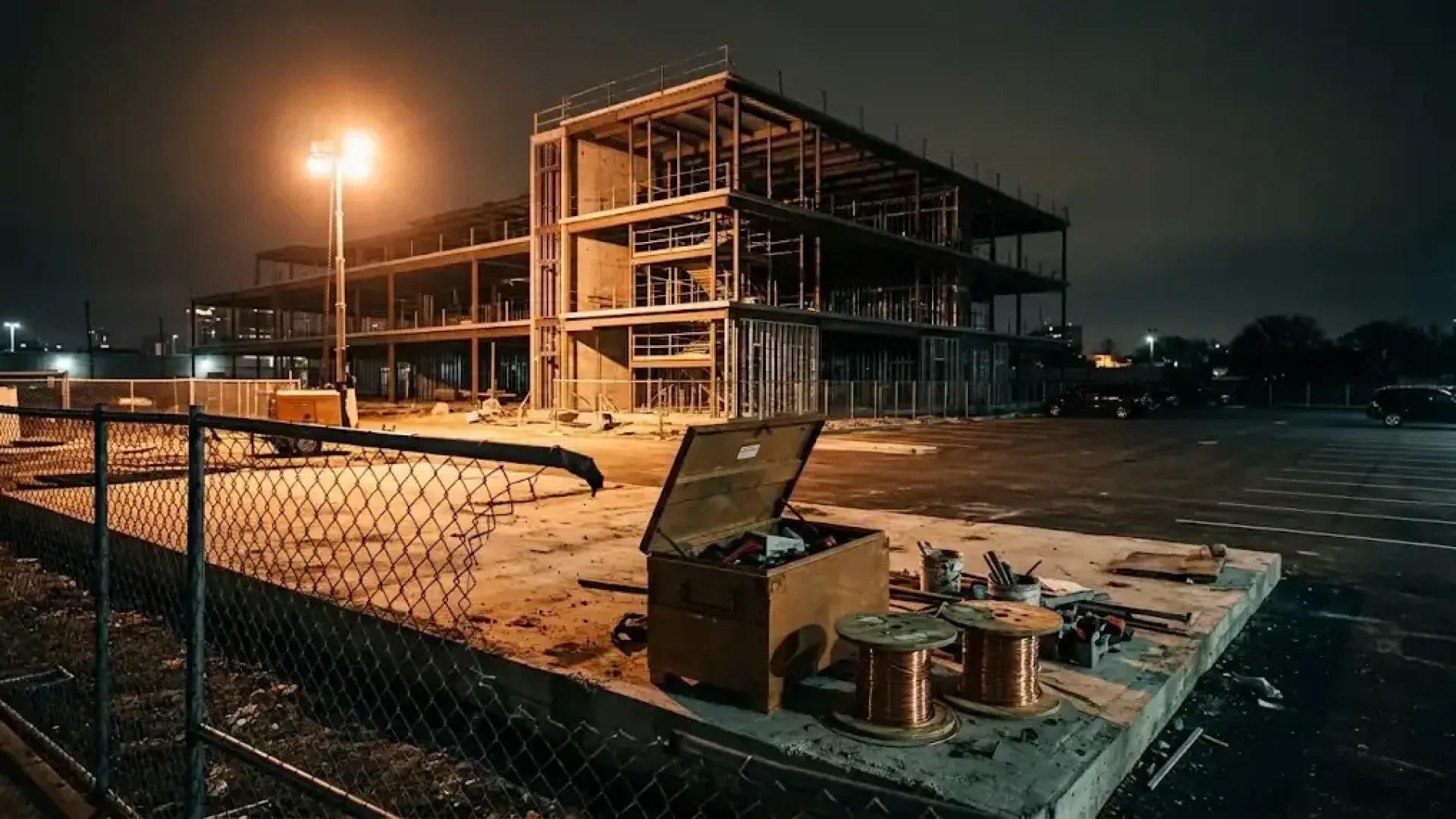
Four break-ins didn’t make the site a target. Being unwatched did.
Security takeaway: A job site holding tools and copper overnight with no detection is not “waiting to be secured.” It is open. Cameras and alarms bought after the third loss help catch the fourth crew; they do nothing for the $35,000 that already left.
Four Nights, Two Crews, One Unfinished School
An elementary school under expansion in Del City, Oklahoma, was burglarized on four separate occasions this summer, according to the Del City Police Department. Investigators say the thefts were the work of two different groups with no connection to each other. Each found the same thing: a site with construction materials and copper lying in the open and nobody there at night.
The losses came to roughly $35,000 in tools and copper, plus more than $5,000 in damage done getting to it. Five people have been arrested: Amber Gibson, Brandon Glover, Deunta Johnson, Thomas Leach, and Cameron Kinsella. Police are still looking for two more.
“The school is working to expand. During that, there’s obviously a lot of construction materials and copper lying around, which makes it a target for the thieves,” Lt. Blake Reichert told KFOR.
Why Copper on a Job Site Sells Itself
Copper is the one material on a construction site that converts to cash the same day, at a scrap yard, with no serial number to trace. It also has to be on site before walls close, which means for weeks it sits in spools and stubbed-out runs that anyone with bolt cutters can harvest.
Tools are the second tier. Contractors’ saws, drills, and generators are easy to carry, easy to resell, and rarely photographed or serialized before they disappear. A crew that hits a site once and finds both will come back, and a second crew that hears about it will show up on its own. That is what happened in Del City: four visits, two unrelated groups, one site that looked the same each time.
The Cameras Went Up After the Loss
The most important line in the police account is the last one. After the thefts, the construction company installed security cameras, motion-activated alarms, and a notification system that reached police quickly. That is what turned a series of cold burglary reports into arrests.
It is also an admission of sequence. Detection arrived after the site had already been robbed several times. Everything that came before was insurance paperwork. The equipment that eventually caught the crews would have cost the same in June as it did in September; the difference is what it would have prevented.
Three Hundred Miles North, Same Two Weeks
Northern California saw the same pattern on two smaller stages in the same period. In Cottonwood, a man entered the grounds of Evergreen School between 1:30 and 2:11 a.m. on August 27 and took about $3,800 in tools from a building under construction on campus. The Tehama County Sheriff’s Office identified him through public tips and license plate reader data and arrested him September 4, per KRCR.
In Lake County, deputies investigating a utility vehicle stolen from Upper Lake Elementary in mid-September traced the suspects’ truck through Flock plate reader alerts to a load under a blue tarp. It was roughly $20,000 in copper wire taken from PG&E yards in Lakeport. Four people were arrested on receiving stolen property and conspiracy charges, per the Lake County Sheriff’s Office.
Three cases, three counties, one common thread: the theft was solved by cameras and plate readers, and prevented by nothing.
Who Is Exposed Right Now
- School districts with bond-funded construction running through the fall, where sites sit idle from Friday afternoon to Monday morning
- General contractors staging copper, conduit, and mechanical equipment ahead of rough-in
- Subcontractors who leave tools in job boxes on site because hauling them nightly costs labor
- Any site whose only after-hours protection is a fence, a padlock, and a “No Trespassing” sign
Five Questions for Any Site Holding Materials Overnight
1. If someone cut the fence at 2 a.m., who would know before 6?
If the honest answer is “the first worker on site,” the site has no detection, only discovery.
2. Where does the copper sleep?
Spools and stubbed runs in an open slab are an invitation. Locked conex boxes inside the lit, camera-covered part of the site change the math.
3. Is there a person, or only a sensor?
A motion alarm that texts a superintendent at 2 a.m. still depends on a superintendent who wakes up and a patrol car that is not busy. Licensed security patrol on a random schedule gives thieves something a sensor cannot: uncertainty.
4. Are tools photographed and serialized before they go on site?
Recovery in Del City and Lake County depended on someone proving what was theirs. A ten-minute inventory at mobilization is what makes that possible.
5. Did the plan start at mobilization or after the first loss?
Every site in this story bought its security after being robbed. The bid should have carried it from day one.
Deterrence Has to Arrive Before the First Loss
Cameras, plate readers, and community tips did impressive work in all three of these cases. They also did it after the fact. The Del City site was hit four times because, for four nights, nothing on that site told a thief he was being watched or that anyone was coming.
Detection is the layer that gets the arrest. Deterrence and response are the layers that keep the copper on the spool. A construction security plan that only includes the first is a plan for good police reports.
How SPADE Covers Active Job Sites
SPADE Security Services builds construction site programs around the hours the site is empty, not the hours it is busy. That means a site assessment before materials arrive, lit and camera-covered staging for high-value stock, licensed mobile patrol on unpredictable rounds, and remote video monitoring with a human on the other end who can dispatch a patrol, not just send a text. Our Scan, Patrol, Advise, Defend, Encrypt model is designed so the first sign of trouble is met with a response, not filed as a loss.
Schedule a Construction Site Security Consultation
SPADE Security Services | Rocklin, CA | Veteran-owned | DVBE certified
Serving Placer, Sacramento, and El Dorado counties
Licensed by the California Bureau of Security and Investigative Services
PPO121804
Why are school construction sites targeted so often?
They combine high-value materials, predictable empty hours, and public, easily observed locations. Bond-funded projects also run on long schedules, so copper and equipment sit on site for weeks before walls close.
Do cameras stop construction site theft?
Cameras identify thieves after the fact and are essential for arrests and recovery. On their own they rarely stop a crew that has already decided nobody is coming. Pairing them with a monitored alarm and a patrol response is what changes behavior.
What should be locked up overnight on a job site?
Copper wire and fittings, power tools, generators, and anything with resale value that is not bolted down. Store them in locked containers inside the lit, camera-covered portion of the site, and log serial numbers before mobilization.
How quickly can a security plan be put on a site that has already been hit?
A site assessment and patrol schedule can usually start within days. The point of this story is that it should start with the bid, before the first spool of copper is delivered.
SPADE Security Services | Rocklin, CA | Veteran-owned | DVBE certified | Serving Placer, Sacramento & El Dorado counties
Licensed by the California Bureau of Security and Investigative Services


THE ACE IN SECURITY
Menu
Stay Ahead of Security Threats
Get Spade Security’s latest insights, incident breakdowns and company news in your inbox — only when we publish.
Text size: 100%