
Smash-and-Grab Crime at Retail Centers Has Quietly Become the Most Common Violent Property Incident in the U.S. Most Operators Are Still Planning for Last Decade's Risk.
Author
Pranil Shankar
Post Date
July 29, 2026
Views
167
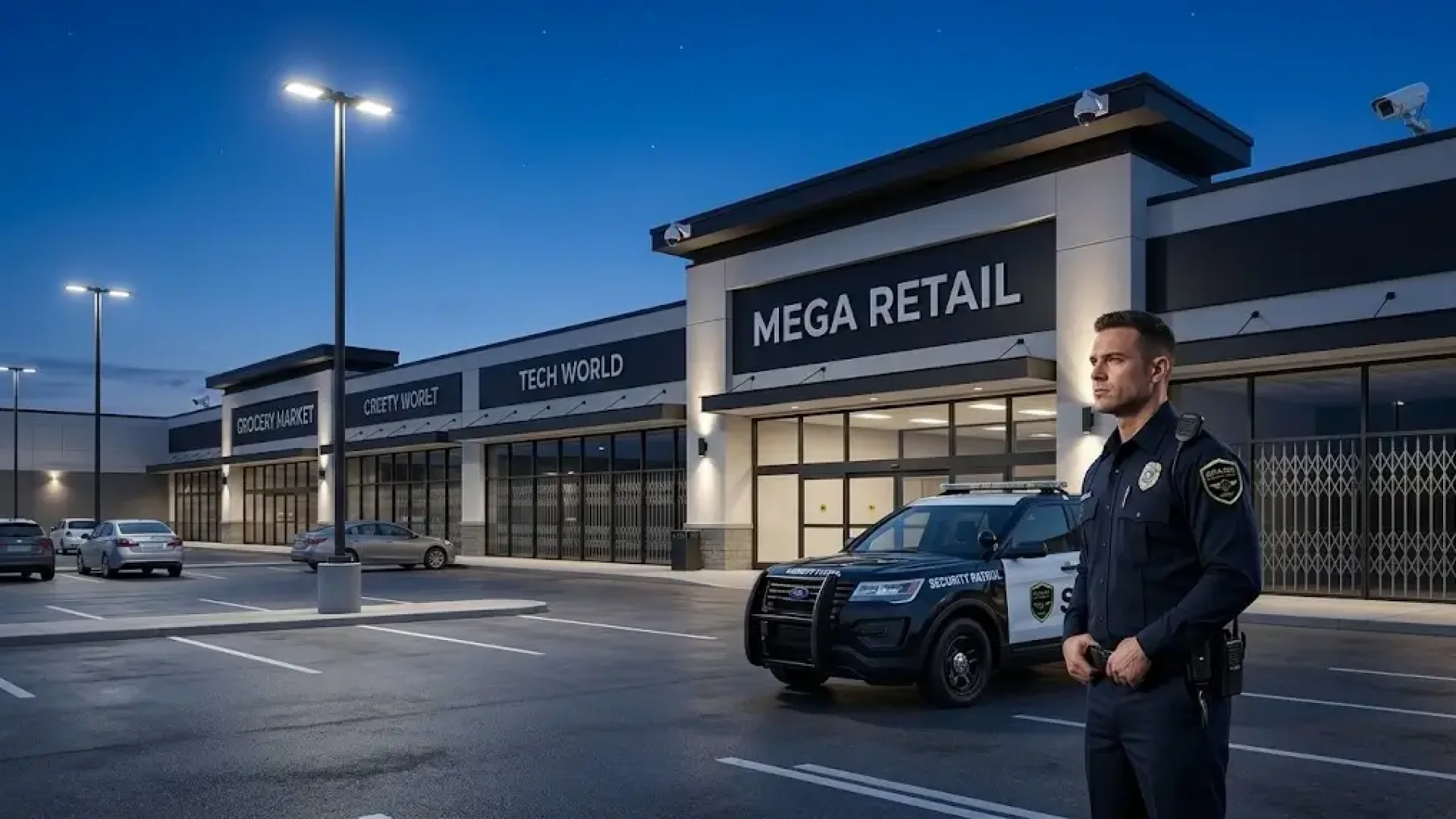
Retail Centers Built Their Security Plans Around Yesterday’s Threats. Organized Crews Are Exploiting the Gap in Broad Daylight.
Raw shoplifting incident counts actually declined in the latest reporting period — but the National Retail Federation’s 2026 survey found that 73 percent of retailers report shoplifters exhibiting more violence and aggression than a year earlier, retail employees reported a 40 percent increase in confrontations with shoplifters, and 67 percent of retailers say transnational organized retail crime groups were involved in thefts against their company in the past year.
The findings indicate that the risk at retail centers has shifted in character, not just volume: fewer, more organized, more violent incidents — with retail centers, not standalone stores, increasingly the operating environment because of predictable anchor store hours, shared parking, and limited after-hours oversight.
What Happened?
According to retail crime analysts, organized groups are increasingly targeting retail centers because the property environment — multiple tenants, shared exterior, mixed operating hours — creates predictable gaps between the time the last store closes and the time the property is fully secured.
Typical operations involve:
- Pre-operational surveillance of center closing routines and guard patrol timing
- Coordinated entry through glass storefronts, back-of-house doors, or rooftop hatches
- Targeted theft of high-value electronics, cosmetics, and designer apparel
- Vehicle staging in parking lot blind zones for rapid loadout
- Resale through online marketplaces and pop-up retail within hours
Unlike opportunistic theft, these operations are timed to coincide with the period when tenant alarms are active but center-level monitoring has not been verified.
Suburban and exurban retail centers — including those in Northern California — face growing exposure as organized crews increasingly target properties outside the dense urban cores where security staffing has traditionally concentrated.
Because most incidents occur after anchor store close and before dawn, affected centers may not detect the full scope of activity until morning tenant walk-throughs.
Why It Matters to Commercial Property Operators
The trend highlights a security issue retail center operators cannot afford to overlook:
The technology protecting your property can become part of the exposure if it is not aligned with how the center actually operates after hours.
Modern retail centers may rely on multiple layers of protection, including:
- Center-wide video surveillance with recorded retention
- Tenant-managed intrusion and panic alarms
- Access control on common-area doors and back-of-house entries
- Roving security patrols during operating hours
- After-hours alarm monitoring and remote verification
- Lighting design across parking and service areas
- Coordination with local law enforcement
Each layer can provide protection.
But each layer also needs to be maintained, monitored, and considered as part of the center’s overall security strategy.
The Security Gap
A retail center can have cameras covering every storefront while the service corridor behind the anchor remains unwatched for a four-hour window between last tenant lock-up and patrol pass-through.
That creates a gap between recorded coverage and verified response.
The question is no longer simply whether the property has cameras.
The more important question is whether the system is being watched, verified, and acted upon during the specific hours when incidents actually occur.
What Retail Center Operators Should Review
1. Know What Closes and When
Maintain an accurate record of tenant operating hours, alarm arming schedules, and the gap between last tenant close and first morning open. Build the security plan around that gap.
2. Monitor Tenant Alarm and Camera Health
A camera that recorded nothing useful is not a security system — it is storage. Operators should verify that tenant systems are online, recording, and reviewed by a documented process.
3. Protect the Physical Property
Technology should complement — not replace — physical security measures such as lighting, perimeter fencing where applicable, controlled service-area access, and after-hours mobile patrol.
4. Identify High-Value Exposure and Connect Detection With Response
Determine which anchor tenants, storefronts, and service zones carry the greatest incident risk and whether those areas receive appropriate monitoring and verification after center close.
A motion alert at a back-of-house door has limited value if nobody is responsible for verifying it and determining what happens next.
Establish a clear after-hours response process with defined roles and escalation contacts.
The Bigger Lesson
The retail crime data is not simply a story about one category of property.
It demonstrates how commercial property security is becoming increasingly dependent on both physical protection and verified after-hours monitoring.
Protecting a retail center requires more than installing cameras and signing a patrol contract.
Operators need to understand what those systems do, how they are maintained, where vulnerabilities exist, and how technology connects to the physical security operation.
A More Complete Approach to Retail Center Security
SPADE Security Services helps retail center operators build security programs around the actual conditions of their tenants, hours, and after-hours exposure.
Our approach can combine intelligent surveillance, remote monitoring, licensed security personnel, patrol, visible deterrence, access management, and response based on the property’s specific exposure.
The objective is not to replace one security layer with another.
It is to make the layers work together.
Because protecting a retail center isn’t simply about installing another camera.
It’s about making sure the different layers of protection work together when the last tenant closes and the center is most exposed.
Your tenants trust you with their storefront. Your security strategy should be built around protecting it.
Schedule a Retail Center Security Consultation
SPADE Security Services | Rocklin, CA | Veteran-owned | DVBE certified
Serving Placer, Sacramento, and El Dorado counties
Licensed by the California Bureau of Security and Investigative Services
PPO121804
What should a retail center operator do first after a smash-and-grab incident?
Operators should preserve all available camera footage, file a police report, coordinate with affected tenants, and review the incident timeline against patrol and alarm response records.
They should also engage their security partner to assess whether the gap exploited during the incident has been closed or remains open.
Does having tenant cameras and a patrol car mean a retail center is fully protected?
No. Tenant cameras and patrol presence are one layer of protection.
Operators should also consider center-wide video monitoring, after-hours alarm verification, service-area access control, lighting design, coordination with law enforcement, and an established response process.
Why does after-hours security matter for retail centers?
Retail centers remain exposed after the last tenant closes, often for a window of several hours before any personnel returns.
Without appropriate monitoring and response, suspicious activity may not be identified until after storefronts have been breached, merchandise has been removed, and the operation has cleared the property.
How can retail center operators improve their overall security strategy?
Start by identifying the tenants, zones, and hours carrying the greatest incident risk.
From there, security technology, personnel, monitoring, patrol, and response can be coordinated around the center’s actual operating profile and exposure window.
SPADE Security Services | Rocklin, CA | Veteran-owned | DVBE certified | Serving Placer, Sacramento & El Dorado counties
Licensed by the California Bureau of Security and Investigative Services


THE ACE IN SECURITY
Menu
Stay Ahead of Security Threats
Get Spade Security’s latest insights, incident breakdowns and company news in your inbox — only when we publish.
Text size: 100%