
Police Charged Two Teens in a Roanoke Break-In Within Hours. The Business Still Got Hit First.
Author
Pranil Shankar
Post Date
September 14, 2026
Views
167
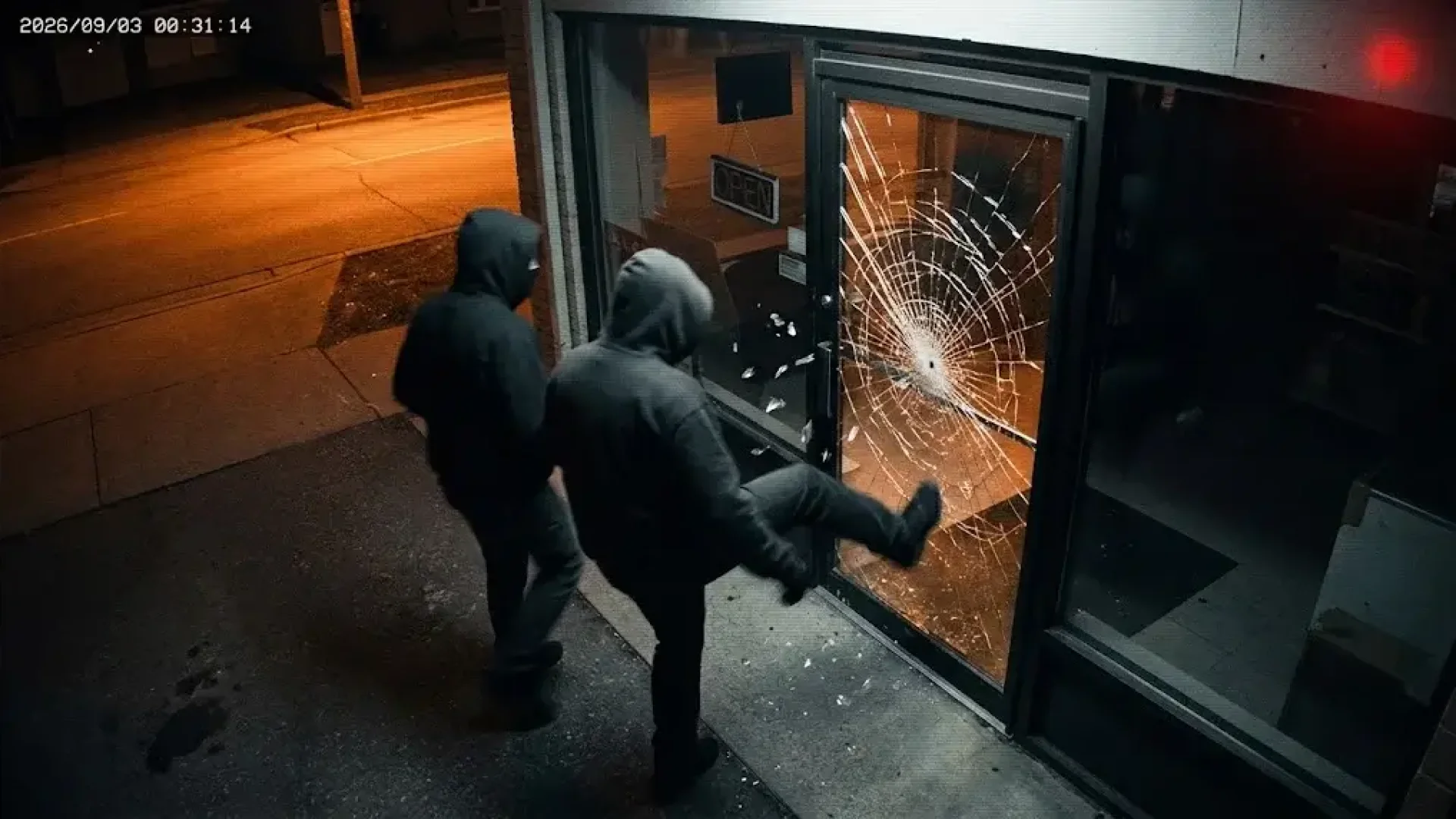
Cameras didn’t stop the break-in. They just made sure it didn’t stay a mystery.
Security takeaway: Detection tells you who. It does not change whether. A camera and an alarm turned this break-in into a solved case within hours — and did nothing to keep the front door in one piece.
Orange Avenue, 12:30 a.m.
Around 12:30 a.m. on September 3, 2026, an alarm system alerted Roanoke, Virginia police to a business in the 2500 block of Orange Avenue. Arriving officers found signs of forced entry.
Security video showed two people breaking the front door and going inside. From that footage, police identified 19-year-old Benjamin Reece Sparks, Jr. and 18-year-old Landon Troy Cottrell, both of Roanoke. Both were located and arrested later that same morning, charged with burglary, and held at the Roanoke Adult Detention Center.
Those are the documented facts, per WSET’s report.
What the Footage Could and Couldn’t Do
Judged as a detection system, this business had a good night. The alarm reached police while the entry was fresh. The camera angle on the front door was clean enough to put names to two faces within hours. Most burglaries do not close that fast, and many never close at all.
Judged as a security system, the same night reads differently. Every layer that worked was a layer that starts after the door is already broken. Nothing in place made the door harder to open, made the two of them reconsider on the sidewalk, or shortened the time between the first kick and the first responder.
The technology did its job completely. Its job was just narrower than the owner’s problem.
The Twelve Seconds Nobody Was Covering
A standard glass storefront door with off-the-shelf hardware fails in seconds to a boot, a pry bar, or a thrown object. The alarm signal, the dispatch, and the drive time all happen on the other side of that moment.
That is the gap in a detection-first setup: the interval between the decision to break in and the moment anyone can respond is entirely undefended. Cameras record it. Alarms report it. Neither one occupies it.
Who Is Running Detection-Only Security
- Small retailers and service businesses whose entire after-hours plan is an alarm contract and a camera app
- Storefronts with standard glass doors and consumer-grade locks, with no reinforcement at the frame or strike
- Businesses on corridors that go quiet after closing, where a broken door draws no attention for hours
- Owners who have never had a break-in and measure their security by the absence of one
Four Questions for Your Front Door
1. How long does it actually hold?
Have someone qualified assess the door, frame, glass, and strike plate. If the honest answer is “seconds,” reinforcement is the cheapest security upgrade you will buy this year.
2. What would make someone walk past?
Lighting, visible cameras at eye level, and a patrol vehicle that passes at unpredictable times change the decision before it is made. A hidden camera only helps afterward.
3. Who is closest at 12:30 a.m.?
Know your realistic response time — not the alarm company’s, the person who will physically arrive. Then ask whether a patrol presence overnight would cut it.
4. What is the plan for 7:00 a.m.?
An arrest does not board up a door, restock a shelf, or reopen on time. Have the board-up contact, the insurance documentation steps, and the camera-export procedure written down before you need them.
Solved Is Not the Same as Prevented
Trace what each layer delivered here. The camera delivered identification. The alarm delivered notification. The police delivered an arrest. None of those layers delivered a door that stayed shut, and none was designed to.
Deterrence and delay sit ahead of detection in any complete plan. Response sits behind it. Documentation ties all of it together so the next incident is not a fresh start. Building only the middle of that sequence produces exactly this outcome: a clean case file and a broken storefront.
How SPADE Layers Prevention Ahead of Detection
SPADE Security Services builds commercial programs that start before the door: entry-point assessment and reinforcement guidance, visible camera and lighting placement meant to be seen, and licensed overnight patrol that puts a person on the block during the hours forced entries actually happen.
Monitored alarm response and incident documentation still belong in the plan. They are the layers that make sure a break-in gets solved. The layers in front of them are what give the business a chance to not need solving.
Schedule a Retail & Commercial Security Consultation
SPADE Security Services | Rocklin, CA | Veteran-owned | DVBE certified
Serving Placer, Sacramento, and El Dorado counties
Licensed by the California Bureau of Security and Investigative Services
PPO121804
How fast can police identify suspects from camera footage?
It varies widely. Clear, well-positioned footage — like the front-door angle in this case — can produce identifications and arrests within hours. Poor angles or low light can leave a case open indefinitely.
Do cameras and an alarm mean a break-in won’t happen?
No. Both are detection tools: they report and record a breach. They do not physically resist forced entry or shorten the time before someone arrives, which is why they work best behind reinforcement, lighting, and patrol.
What makes a storefront door an easy target?
Standard glass and consumer-grade hardware give way in seconds with minimal tools, and most storefronts have no reinforcement at the frame, strike plate, or glazing.
What should a business do immediately after a forced-entry break-in?
Call police before touching anything, export the camera footage before it overwrites, photograph the entry point and any damage, and document what is missing for both the police report and the insurance claim.
SPADE Security Services | Rocklin, CA | Veteran-owned | DVBE certified | Serving Placer, Sacramento & El Dorado counties
Licensed by the California Bureau of Security and Investigative Services


THE ACE IN SECURITY
Menu
Stay Ahead of Security Threats
Get Spade Security’s latest insights, incident breakdowns and company news in your inbox — only when we publish.
Text size: 100%