
Health Facility Emergency Departments Are Now the Most Common Site of Workplace Violence in U.S. Healthcare. The Risk Doesn't End at the Triage Desk.
Author
Pranil Shankar
Post Date
August 10, 2026
Views
186
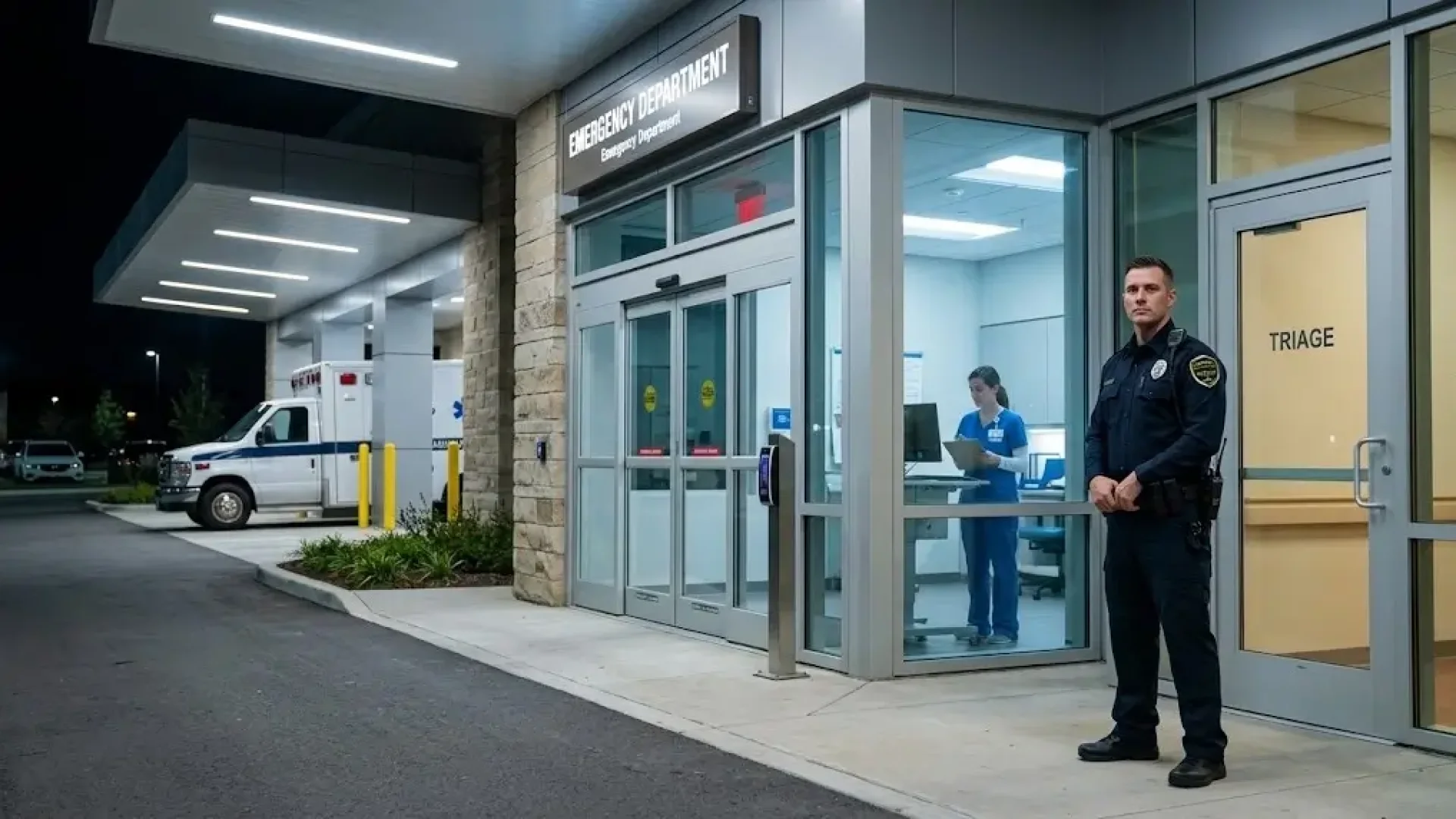
Emergency Departments Were Built to Save Lives, Not Defend Them. Healthcare Security Data Shows the Threat Inside the Waiting Room Is Escalating Fast.
Healthcare workers experience some of the highest workplace violence rates of any industry: assaults account for 25 percent of healthcare workplace injuries that cause days away from work, according to Bureau of Labor Statistics data, and CDC/NIOSH estimate 1 in 7 healthcare workers experience violence serious enough to miss work. Emergency departments see more than 7,000 clinician injuries from workplace violence every year in the U.S., with one systematic review finding that 56.5 percent of healthcare employees reported experiencing workplace violence in the past year.
The findings indicate that the security challenge at health facilities has shifted from interior behavioral units to the perimeter, the parking structure, and the arrival flow.
What Happened?
According to healthcare safety investigators, the documented rise in incidents is concentrated in three areas: the emergency department entrance, the perimeter during behavioral health crisis arrival, and the parking structure during overnight shifts.
Typical incidents involve:
- Verbal and physical assault against triage and registration staff
- Behavioral health crisis arrival escalating before clinical assessment
- Threats made through the main entrance during high-volume periods
- Incidents in parking structures and walking paths during overnight shifts
- Unauthorized access to restricted clinical and supply areas
Unlike general workplace violence, healthcare incidents frequently involve individuals under acute stress, altered mental status, or the influence of substances — requiring a different security posture than conventional commercial facilities.
Suburban and exurban hospital campuses — including those across Northern California — face growing exposure as emergency department volumes rise and behavioral health crisis arrivals increasingly bypass the controlled interior spaces the facility was designed to protect.
Because most incidents are reported internally and resolved without prosecution, affected facilities may not recognize the pattern until staff turnover, claim frequency, or regulatory review surfaces the data.
Why It Matters to Health Facility Operators
The trend highlights a security issue healthcare administrators cannot afford to overlook:
The technology protecting patient data and clinical operations may not extend to the people providing care at the front door.
Modern health facilities may rely on multiple layers of protection, including:
- Surveillance cameras across entrances, lobbies, and parking structures
- Access control on clinical, pharmacy, and behavioral health areas
- Duress alarms and panic buttons for clinical staff
- Security personnel at the main entrance and emergency department
- Visitor management and identification procedures
- Coordination with local law enforcement and security partners
- Workplace violence training and de-escalation programs
Each layer can provide protection.
But each layer also needs to be maintained, monitored, and considered as part of the facility’s overall security strategy.
The Security Gap
A health facility can have controlled pharmacy access while the emergency department entrance remains open during a documented surge in behavioral health arrivals.
That creates a gap between controlled access and front-line safety.
The question is no longer simply whether the facility has controlled access.
The more important question is whether the people arriving at the front door — under stress, in crisis, or under the influence — are met with a security posture that supports safe clinical care.
What Health Facility Operators Should Review
1. Know the Highest-Risk Entry Points and Hours
Maintain an accurate record of incident patterns by entrance, shift, and patient population. Build the security plan around the documented peaks, not the assumed ones.
2. Monitor Workplace Violence and Regulatory Advisories
Healthcare workplace violence evolves with community conditions. Facilities should have a process for tracking OSHA guidance, Joint Commission alerts, and regional healthcare safety bulletins.
3. Protect the Physical Facility
Technology should complement — not replace — physical security measures such as lighting, controlled waiting room design, behavioral health room hardening, secure staff corridors, and visible security presence at documented peak times.
4. Identify High-Value Exposure and Connect Detection With Response
Determine which entrances, units, and shifts carry the greatest incident risk and whether those areas receive appropriate monitoring, response, and post-incident review.
A duress alarm at the triage desk has limited value if nobody is responsible for verifying it and determining what happens next.
Establish a clear incident response process with defined roles and escalation contacts.
The Bigger Lesson
The healthcare workplace violence data is not simply a story about one category of facility.
It demonstrates how health facility security is becoming increasingly dependent on both controlled access and front-line safety.
Protecting a health facility requires more than installing cameras and access control.
Operators need to understand what those systems do, how they support staff during incidents, where vulnerabilities exist, and how technology connects to the physical security operation from arrival to discharge.
A More Complete Approach to Health Facility Security
SPADE Security Services helps health facilities build security programs around the actual conditions of their entrances, units, and shift patterns.
Our approach can combine intelligent surveillance, remote monitoring, licensed security personnel, patrol, visible deterrence, access management, and response based on the facility’s specific exposure.
The objective is not to replace one security layer with another.
It is to make the layers work together.
Because protecting a health facility isn’t simply about installing another camera.
It’s about making sure the different layers of protection work together when the emergency department is full and the staff are most exposed.
Your staff care for patients under stress. Your security strategy should support them.
Schedule a Health Facility Security Consultation
SPADE Security Services | Rocklin, CA | Veteran-owned | DVBE certified
Serving Placer, Sacramento, and El Dorado counties
Licensed by the California Bureau of Security and Investigative Services
PPO121804
What should a health facility do first after a workplace violence incident?
Facilities should ensure the safety of involved staff and patients, preserve all camera footage and access logs, document the incident with clinical and security staff input, and report as required to regulators and law enforcement.
They should also engage their security partner to evaluate whether the exploited gap is limited to that area or reflects a broader pattern across shifts and entrances.
Does having cameras and a security desk mean a health facility is fully protected?
No. Cameras and a security desk are one layer of protection.
Facilities should also consider duress alarms, controlled waiting room design, behavioral health room hardening, secure staff corridors, after-hours monitoring, and an established incident response process.
Why does after-hours security matter for health facilities?
Hospital campuses remain operational 24 hours a day, with documented risk patterns during overnight shifts and weekend behavioral health arrival surges.
Without appropriate monitoring and response, incidents may not be identified until after staff have been assaulted, patients have been injured, or restricted areas have been breached.
How can health facility operators improve their overall security strategy?
Start by identifying the entrances, units, and shifts carrying the greatest incident risk.
From there, security technology, personnel, monitoring, patrol, and response can be coordinated around the facility’s actual arrival patterns and clinical risk profile.
SPADE Security Services | Rocklin, CA | Veteran-owned | DVBE certified | Serving Placer, Sacramento & El Dorado counties
Licensed by the California Bureau of Security and Investigative Services


THE ACE IN SECURITY
Menu
Stay Ahead of Security Threats
Get Spade Security’s latest insights, incident breakdowns and company news in your inbox — only when we publish.
Text size: 100%