
- Industries
- Commercial Property ManagementParking lots, lobbies and common areas protected day and night.
- ConstructionJob site theft and after-hours break-ins, covered until the crew returns.
- Logistics and WarehouseGates, yards and loaded trailers watched and logged around the clock.
- AutomotiveLots, keys and inventory protected while the dealership is closed.
- EducationCampuses, doors and after-hours events kept safe.
- Health Care FacilityVisitor screening, patrols and monitoring for healthcare buildings.
- Services
- Security Guards & PatrolLicensed officers at the gate or on mobile patrol, with GPS-verified logs.
- Drone & RoboticsAerial and robotic patrols for large or hard-to-reach sites.
- Security TrailersMobile surveillance units that can be deployed within hours.
- Security CamerasCamera systems built to detect and report, not just record.
- Video MonitoringAI flags it, a human verifies it, and dispatch follows. 24/7.
- NotaryNotary public services for your business.
- Live ScanLive Scan fingerprinting for background checks.
- Resources
- About us
- Careers
Retail Theft in Sacramento: How Small and Mid-Size Retailers Are Fighting Back
Author
Pranil Shankar
Post Date
June 3, 2026
Views
236
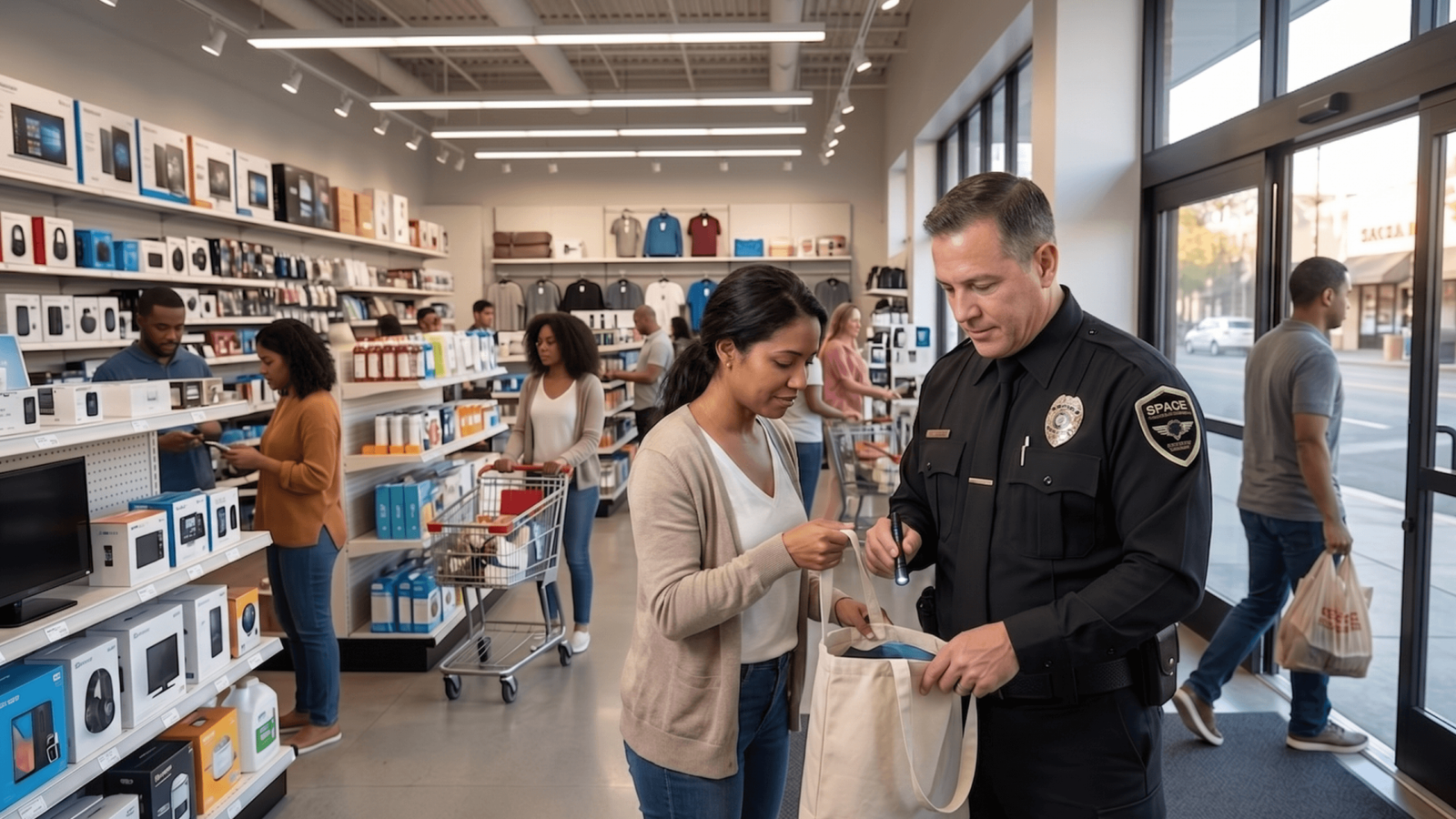
You already know the number. Shrink. Somewhere between two and four percent of annual revenue gone — to shoplifting, employee theft, vendor fraud, and the organized retail crime operations that have made Sacramento one of the most targeted retail corridors in Northern California.
For a large format retailer, those percentages are a line item with a dedicated loss prevention department behind it. For a single-location retailer in Roseville, a franchise operator with three stores in the Sacramento region, or a shopping center manager responsible for a dozen tenants, those same percentages represent something more immediate: the difference between a profitable year and a conversation with ownership about why margins came in short.
In 2026, retail theft in Sacramento is not primarily a spontaneous, opportunistic crime. It is increasingly organized, targeted, and executed by operations that have already surveilled your store, identified your busiest coverage windows, and determined exactly which products and routes give them the highest return with the lowest risk of intervention. The store without visible security is not just a target — it is the easiest target in the corridor.
This post explains what is driving organized retail theft in the Sacramento region, what it actually costs a mid-size retail operation, and what security measures Sacramento-area retailers are using right now to reduce loss and protect their margin.
Why is organized retail theft increasing in Sacramento and Roseville in 2026?
Sacramento has become one of the most active organized retail crime (ORC) regions in California for a combination of reasons that converge in 2026.
The retail density of corridors like Roseville’s Galleria area, Rocklin’s commercial strips, and Sacramento’s major shopping centers creates a high-value target concentration that organized operations exploit systematically. Unlike a single-store shoplifter acting opportunistically, organized retail crime operations work in coordinated groups, target specific product categories with established resale channels, and move through multiple stores in the same corridor on the same day.
The product categories most frequently targeted by ORC operations in the Sacramento area include the following:
- Health and beauty products — high resale value, easy concealment, and consistent secondary market demand.
- Over-the-counter medications — frequently targeted due to established resale channels and self-service placement.
- Alcohol — high unit value and predictable demand in secondary markets.
- Electronics accessories — compact, high-value, and easily resold through online platforms.
- Apparel — targeted in volume by coordinated groups moving through multiple locations in a single corridor on the same day.
The legal environment has also shifted the calculus for individual shoplifters. Changes in prosecution thresholds for petty theft have reduced deterrence for opportunistic theft in some jurisdictions, creating an environment where visible security presence carries more deterrent weight than the abstract possibility of legal consequence.
What does retail theft actually cost a Sacramento-area retailer beyond the merchandise?
The product cost is what gets recorded. The true cost of retail theft compounds in ways that most retail operators underestimate until they see it fully accounted.
- Direct inventory loss is the most visible number. But the downstream costs that follow are often larger. Shrink that exceeds industry benchmarks triggers conversations with franchisors, ownership groups, and insurance carriers. Insurance premiums on commercial retail policies increase after claims — and repeated claims can affect both renewability and coverage terms.
- Staff safety exposure is the less-discussed cost. As organized retail crime has become more brazen in Sacramento-area stores, confrontations between theft operations and retail employees have increased. An employee confrontation that results in injury creates a workers’ compensation claim, a potential OSHA review, and a staff retention problem that costs more than the merchandise ever did.
- Customer experience degradation is the third cost that rarely appears in shrink calculations. When a retail environment feels unsafe — when customers see theft occurring, when product has to be moved behind locked cases, when the store experience becomes guarded and restricted — those customers make different choices about where they shop. That revenue loss is real and ongoing, and it never shows up in a shrink report.
What security measures are Sacramento retailers using to reduce theft in 2026?
Retailers in Roseville, Rocklin, and across the Sacramento region who have effectively reduced both organized and opportunistic theft share a consistent approach: visible, active deterrence at the right points in the customer journey — not passive detection systems that record what happened after it already happened.
- Uniformed guard presence at entry and high-risk product zones. A uniformed security officer positioned at the store entrance or in the highest-shrink product area of the floor changes the behavioral calculus for both organized and opportunistic theft immediately. Visibility is the primary deterrent mechanism — a guard who is seen is a guard who works. For retailers who cannot justify a full-shift static post, strategically timed guard coverage during the highest-traffic and highest-risk windows delivers the most effective deterrence per dollar spent.
- Loss prevention coordination with a licensed security provider. A professional security company supporting a retail operation is not just a guard presence — it is a partner in loss prevention documentation, incident reporting, and evidence collection that supports prosecution and insurance claims when incidents occur. Retailers working with licensed providers who generate consistent incident reports are in a fundamentally different position when a significant theft event triggers a law enforcement or insurance process.
- Exterior and parking lot coverage. Organized retail crime operations frequently stage outside the store — in parking lots where stolen product is transferred to waiting vehicles. Exterior guard presence or mobile patrol coverage in the parking area during high-risk windows closes a gap that in-store security alone cannot address.
- Event and seasonal coverage. The highest-shrink periods for most Sacramento retailers — holiday season, back-to-school, and major promotional events — are exactly the windows when organized operations increase their activity. Supplemental security coverage during these periods, planned in advance, is a standard practice among retailers who have brought shrink under control.
How do I calculate whether a security guard is worth the cost for my Sacramento retail store?
The math is more straightforward than most retail operators expect, and it tends to resolve clearly once the full cost of shrink is in the frame.
Start with your current annual shrink dollar amount. Then estimate the proportion that is opportunistic or organized retail theft — for most retailers in Sacramento, that number is between 30 and 60 percent of total shrink. Apply a conservative 20 to 40 percent deterrence reduction for visible security presence — industry data consistently supports at least this range for retail environments with uniformed guard coverage.
Compare the resulting annual savings against the annualized cost of the security coverage you are considering. For most mid-size retailers in Roseville or Sacramento with shrink above the two percent threshold, that calculation resolves in favor of security investment before you add any value for staff safety improvement or customer experience protection.
The conversation with ownership or a franchisor is easier when it starts with the math, not the concept.
Why Sacramento retailers choose SPADE Security Services
SPADE Security Services is a veteran-owned, DVBE-certified physical security company headquartered in Rocklin, California. We provide uniformed guard services, mobile patrol, and loss prevention support for retail operations across Sacramento County and Placer County — including single-location retailers, multi-store franchise operations, and shopping center management clients.
Our retail security programs are built around your specific floor plan, your highest-shrink product zones, and your peak-risk hours. We do not apply a template — we build a coverage plan from your actual operational reality and adjust it as your business changes seasonally.
We offer a complimentary retail security assessment for Sacramento-area retailers. We walk your store, review your current shrink data if available, identify your highest-risk windows and positions, and give you a written security recommendation with associated costs that you can take directly to ownership or a franchisor.
Contact SPADE Security Services to schedule your assessment: spadesecurityservices.com | Rocklin, CA | Serving Placer, Sacramento, and El Dorado counties.
Frequently asked questions: retail security in Sacramento and Roseville
What is organized retail crime and how does it differ from regular shoplifting in Sacramento?
Organized retail crime (ORC) refers to coordinated theft operations that target retail stores systematically rather than opportunistically. ORC operations typically involve multiple individuals working in concert, target specific high-value product categories with established resale channels, and operate across multiple stores in a corridor on the same day. Unlike opportunistic shoplifters who respond to perceived risk in the moment, ORC operations surveil targets in advance and select stores with the lowest deterrence. Visible security presence — a uniformed guard at the entry or in the target product area — is the most effective deterrent because it changes the risk calculation before the operation enters the store.
What security guard coverage hours make the most sense for a Sacramento retail store?
For most Sacramento-area retailers, the highest-risk windows are weekend afternoons, evening hours before close, and the first and last hour of operating hours when staffing is thinnest and customer volume is variable. A coverage plan that concentrates guard hours on these specific windows delivers more deterrence value per dollar than full-day static coverage for most single-location retailers. For stores with documented ORC targeting or high shrink in specific product zones, additional mid-day coverage in those areas may be warranted. SPADE designs coverage schedules based on your specific traffic patterns and incident history.
Does having a security guard reduce my retail insurance premiums in Sacramento?
Documented security measures — particularly licensed guard services with written incident reports and patrol logs — are increasingly relevant to commercial retail insurance underwriting in California. Carriers handling retail theft claims look at whether the retailer maintained reasonable security measures as a factor in claims evaluation and premium setting. A contract with a licensed security provider and documented guard activity creates the record that supports your position in both claims processing and premium negotiations.
Can a security guard legally detain a shoplifter at my Sacramento retail store?
California Penal Code Section 490.5 provides retail merchants with the right to detain a person for a reasonable time for the purpose of investigation when the merchant has probable cause to believe the person has stolen merchandise. A licensed security guard acting on behalf of the retailer may exercise this “merchant’s privilege” detention. Detention must be conducted in a reasonable manner, limited to investigation, and must not exceed a reasonable time. Guards must be trained in proper detention procedures — SPADE guards receive training in California retail detention law, appropriate use of force standards, and evidence documentation for prosecution support.
Is SPADE Security Services able to provide loss prevention guards for a multi-location retail operation in Sacramento?
Yes. SPADE Security Services provides guard coverage for single-location retailers and multi-store operations across Sacramento County and Placer County. For franchise operators and multi-location retailers, we develop coverage plans that can be coordinated across locations with consistent reporting formats, centralized incident documentation, and flexible scheduling to match each location’s specific risk profile. Contact us to discuss your specific multi-location requirements and how we build a program around your operational structure.
SPADE Security Services | Rocklin, CA | Veteran-owned | DVBE certified | Serving Placer, Sacramento & El Dorado counties
Licensed by the California Bureau of Security and Investigative Services


THE ACE IN SECURITY
Menu
Stay Ahead of Security Threats
Get Spade Security’s latest insights, incident breakdowns and company news in your inbox — only when we publish.
Text size: 100%