
- Industries
- Commercial Property ManagementParking lots, lobbies and common areas protected day and night.
- ConstructionJob site theft and after-hours break-ins, covered until the crew returns.
- Logistics and WarehouseGates, yards and loaded trailers watched and logged around the clock.
- AutomotiveLots, keys and inventory protected while the dealership is closed.
- EducationCampuses, doors and after-hours events kept safe.
- Health Care FacilityVisitor screening, patrols and monitoring for healthcare buildings.
- Services
- Security Guards & PatrolLicensed officers at the gate or on mobile patrol, with GPS-verified logs.
- Drone & RoboticsAerial and robotic patrols for large or hard-to-reach sites.
- Security TrailersMobile surveillance units that can be deployed within hours.
- Security CamerasCamera systems built to detect and report, not just record.
- Video MonitoringAI flags it, a human verifies it, and dispatch follows. 24/7.
- NotaryNotary public services for your business.
- Live ScanLive Scan fingerprinting for background checks.
- Resources
- About us
- Careers
Apartment Parking Garage Security When the Leasing Office Is Closed
Author
Pranil Shankar
Post Date
October 30, 2026
Views
169
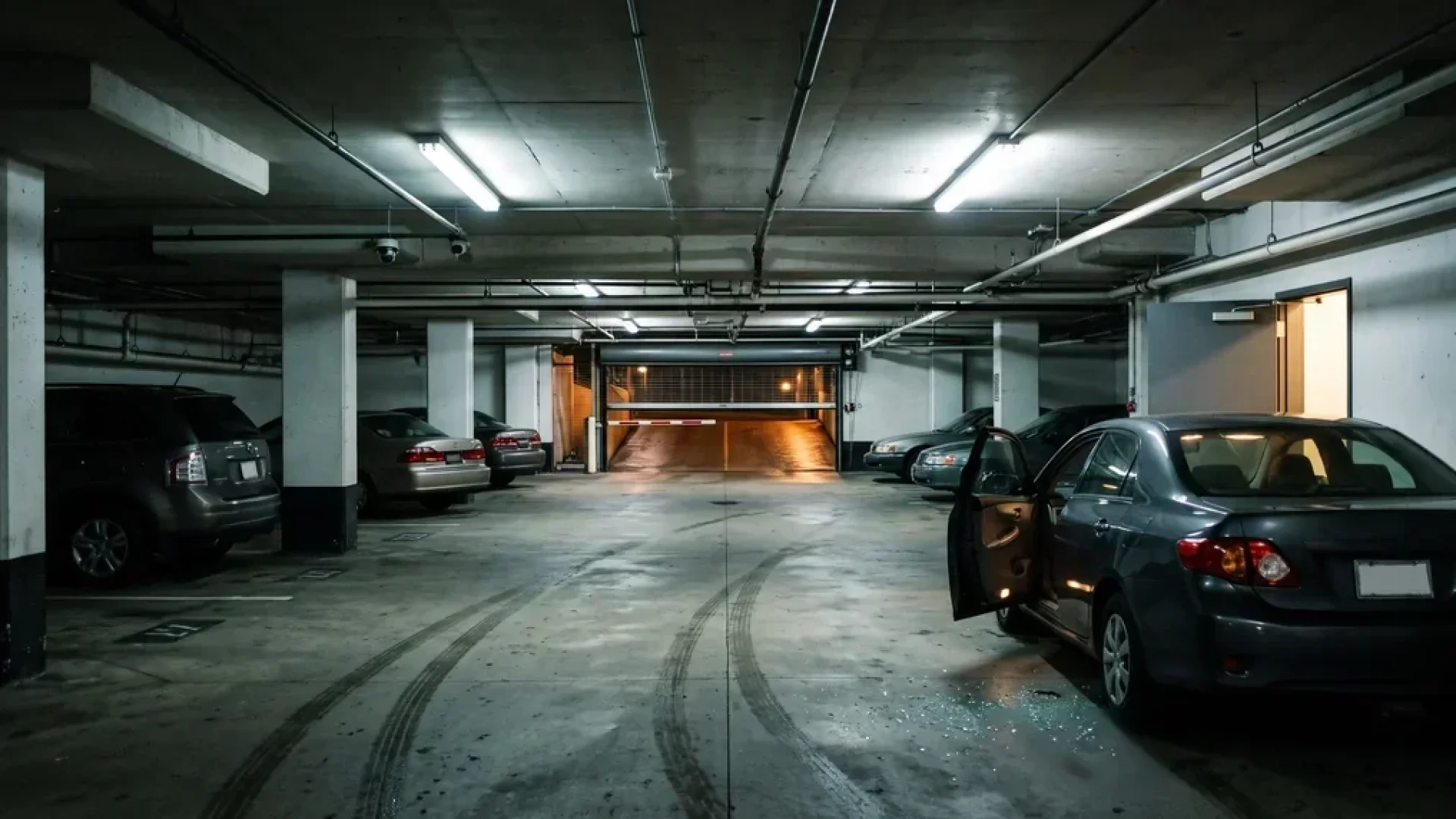
Between the leasing office closing and the first business day, a resident is often the first to notice someone at a car. These measures give that report somewhere to go besides a confrontation.
At many properties the leasing office closes at six. Until staff return the next morning, the first person to notice someone leaning into a car that is not theirs is often a resident, not an employee. A shooting reported in a Brooklyn Park, Minnesota apartment garage on October 25 shows how badly a confrontation over a car can go. For the manager who owns parking at a multifamily property, four questions follow: who owns apartment parking garage security after hours, what record proves the gate and doors worked tonight, what residents are told to do, and where a security vendor fits.
A Theft Interrupted in a Brooklyn Park Apartment Garage
Around 12:56 a.m. on Sunday, October 25, 2026, Brooklyn Park police responded to a report of a shooting at an apartment complex on Louisiana Avenue North, according to KSTP and MN Crime. The man told police he had interrupted someone stealing from his vehicle in the building’s garage; while he confronted that person, a second person shot him, police said. The wound was not life-threatening. Both suspects left before officers arrived, and officers found that several other vehicles in the garage had been tampered with.
Brooklyn Park police told KSTP that a victim being shot during an attempted robbery is incredibly rare in the city, and that anyone who sees a car break-in should stay inside and call police. Retired FBI Special Agent Richard Kolko told KSTP the safer choice is not to confront; he also advised keeping valuables out of parked cars at night and bringing the key fob inside so its panic button can sound the horn.
Police have not described how the two people got into the garage or what security the building has. The question for any manager is about their own garage: after the office closes, who would know a car is being broken into before its owner does?
When Apartment Parking Garage Security Has No Owner After Hours
A resident-only garage usually looks controlled: a gate, fob access, locked stair doors. After hours its protection is often split five ways: an on-call maintenance tech who handles leaks and lockouts, a patrol vendor present at intervals, cameras that record whether or not anyone is watching, police who respond when called, and residents who may never have been told what to do. Each party does its own job. The gap is between them.
When no one owns that gap, nobody confirms tonight that the gate closed, the stair door latched, and the far bay is lit; nobody is designated to take an overnight report, so a resident’s choices narrow to 911 or handling it personally; and the manager hears about the incident from a complaint rather than a record.
Complaints Arrive Before the Record Does
The cost of a garage incident to a manager is rarely the item taken from the car. It is the morning after: a resident asking who pays for the window, a concession request, an hour spent learning whether the camera over that bay recorded anything, and a renewal conversation about whether the resident still feels safe parking there. In the worst case, someone is hurt.
Four Controls Between Close of Business and Morning
1. Write a one-page after-hours responsibility sheet.
List every garage access point (vehicle gate, pedestrian and stair doors, elevator lobby) and name who owns each between close of business and the next business day: on-call manager, maintenance on-call, patrol vendor, or monitoring center, with the number that reaches them and what they do with a report or an alert. The property manager writes it, the regional manager approves it, and each vendor acknowledges it in writing; review it quarterly and after any incident, and post the after-hours line at the garage entries. AIG’s loss-control guidance for apartment buildings recommends written security policies distributed to tenants. A sheet assigns responsibility; it does not create presence, and if the honest overnight entry is “police via 911,” it has shown you the gap.
2. Walk the gate, doors, and lights at close and at open.
The maintenance lead cycles each vehicle gate to confirm it closes, confirms each pedestrian and stair door self-closes and latches unpropped, and checks that lights are on in every bay, stair, and elevator lobby. Each point gets an ID and a pass or fail on a dated checklist, which the property manager reviews weekly; a fail gets a same-day work order plus an interim measure from the responsibility sheet. The Problem-Oriented Policing (POP) guide on thefts from cars in parking facilities reports that electronic access systems have been found effective in housing-complex parking and that poor lighting is a recognized risk factor; the IFPO parking security paper recommends numbered fixtures, one owner for outage reports, and a 24-hour repair target. A check at 6 p.m. records the condition at 6 p.m., not whether the gate stayed closed overnight, and a working gate does not stop someone following a car in on foot. Confirm any lock-down measure with the fire marshal, and leave fixtures and light-level measurement to a licensed contractor.
3. Tell residents what to do instead of confronting.
Issue a short written instruction: if you see someone at a vehicle that is not theirs, stay inside or move away, call 911, then call the property after-hours line; keep valuables and firearms out of parked cars; use the key fob panic button if you see activity from a window. The community manager issues it at move-in, within 48 hours of any garage incident, and in seasonal notices, keeping dated copies. This control needs no purchase. On its own it will not stop theft (the POP guide found lock-your-car campaigns alone showed no clear benefit); its purpose is to keep residents out of harm’s way and get the report to someone who can act.
4. Keep one garage incident log and check the footage within a day.
Every report, including a propped door or gate fault, goes into one log within a business day: time, point ID, what was observed, who reported it, the police report number if one was filed, whether footage was pulled, and which vendor was notified. Within 24 hours of an entry the manager confirms the camera recorded and exports the clip before retention runs out. Review the log monthly with the patrol or monitoring vendor; three entries at the same point in 60 days trigger a specific change with an owner and a date. A log captures what someone reported, and footage shows only what was in frame and lit.
Where SPADE Fits in a Northern California Garage
SPADE Security Services serves Placer, Sacramento, and El Dorado counties and had no connection to the Brooklyn Park property.
SPADE’s video monitoring flags activity on the garage cameras, an operator verifies it, and a response is dispatched, around the clock; the response depends on the contract. That gives an overnight alert a destination besides 911 and supports prevention through deterrence and intervention, without guaranteeing it. It depends on camera placement that covers the bays and stair doors, light the cameras can work in, and an agreed escalation list; police response is not something SPADE controls. SPADE’s camera systems are built to detect and report, not just record, and analytics do not see into an unlit bay, so the lighting work comes first.
SPADE’s patrol officers at the gate or on mobile patrol keep GPS-verified logs. A log records that an officer was at a point at a time, not what happened between visits or the condition of doors the officer did not inspect, so patrol frequency and points are contract terms set against the walk checklist. Documented reporting gives management a clear record of incidents and security activity, the vendor feed the incident log needs. SPADE’s commercial property management page describes combining surveillance, monitoring, personnel, and response to maintain visibility outside normal management hours; the responsibility sheet decides which of those your garage needs.
Start With the Sheet and the Log
The sheet and the log need no new equipment and show where after-hours ownership of the garage actually sits. Then book SPADE’s free, no-obligation security assessment, which evaluates the property, identifies vulnerabilities, and builds a custom protection plan. Bring the sheet and these questions: which openings nobody owns after six, what is watching the bays, who takes the overnight report, and whether the record reaches you before the complaint does.
SPADE is veteran-owned, DVBE certified, and directly employs its officers. We do not subcontract.
Book a garage security assessment
SPADE Security Services | Rocklin, CA | Veteran-owned | DVBE certified
Serving Placer, Sacramento, and El Dorado counties
Licensed by the California Bureau of Security and Investigative Services
PPO121804
SPADE Security Services | Rocklin, CA | Veteran-owned | DVBE certified | Serving Placer, Sacramento & El Dorado counties
Licensed by the California Bureau of Security and Investigative Services


THE ACE IN SECURITY
Menu
Stay Ahead of Security Threats
Get Spade Security’s latest insights, incident breakdowns and company news in your inbox — only when we publish.
Text size: 100%