
- Industries
- Commercial Property ManagementParking lots, lobbies and common areas protected day and night.
- ConstructionJob site theft and after-hours break-ins, covered until the crew returns.
- Logistics and WarehouseGates, yards and loaded trailers watched and logged around the clock.
- AutomotiveLots, keys and inventory protected while the dealership is closed.
- EducationCampuses, doors and after-hours events kept safe.
- Health Care FacilityVisitor screening, patrols and monitoring for healthcare buildings.
- Services
- Security Guards & PatrolLicensed officers at the gate or on mobile patrol, with GPS-verified logs.
- Drone & RoboticsAerial and robotic patrols for large or hard-to-reach sites.
- Security TrailersMobile surveillance units that can be deployed within hours.
- Security CamerasCamera systems built to detect and report, not just record.
- Video MonitoringAI flags it, a human verifies it, and dispatch follows. 24/7.
- NotaryNotary public services for your business.
- Live ScanLive Scan fingerprinting for background checks.
- Resources
- About us
- Careers
Highway Construction Site Security Has to Move With the Work
Author
Pranil Shankar
Post Date
October 26, 2026
Views
196
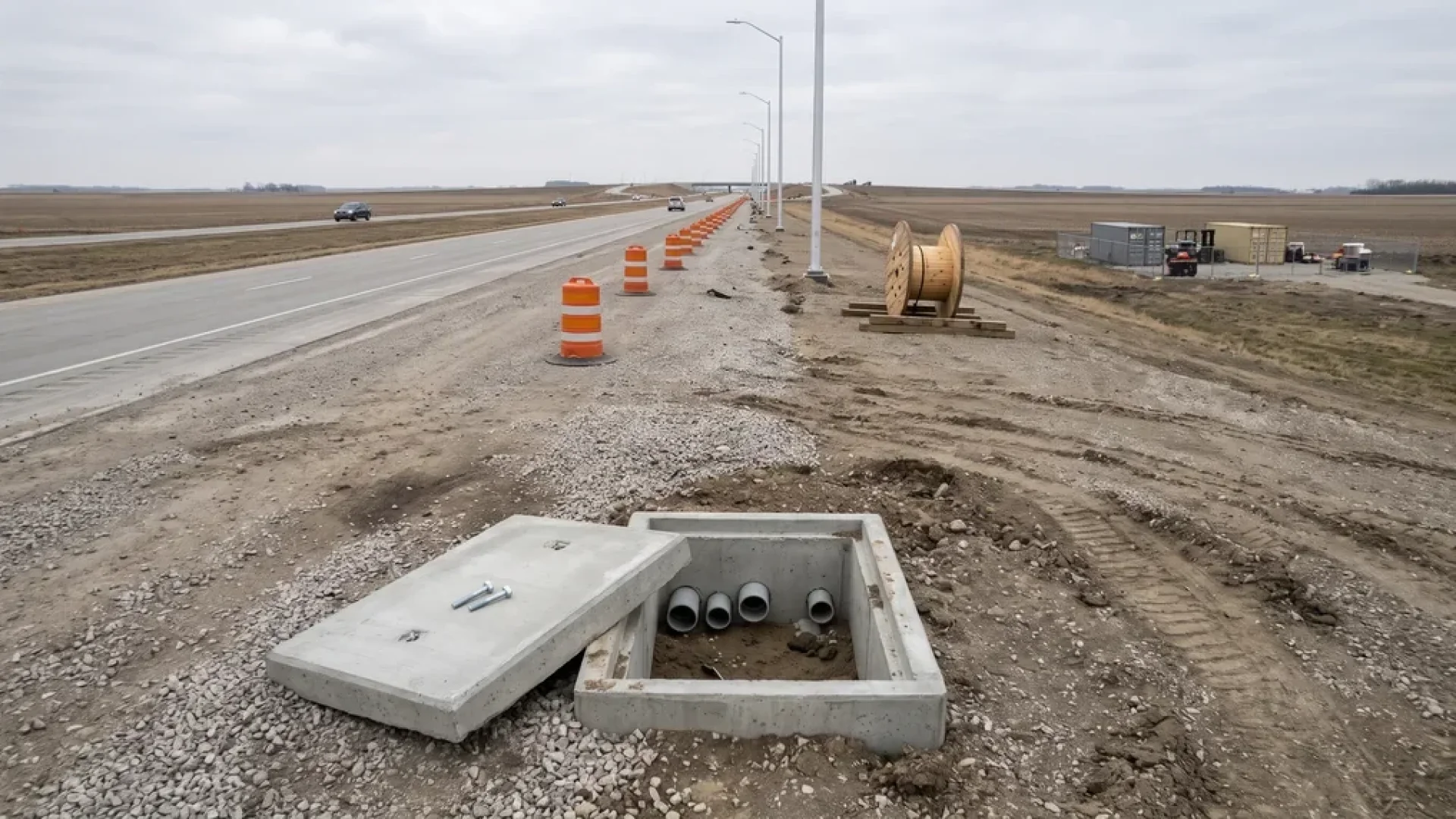
The crew moves on, and the newest pulled conductor stays behind on an open shoulder. That is where coverage, condition records, and incident ownership tend to lag.
On a highway lighting job the exposure is strung out along the corridor. Reels wait at a staging point behind the barrels, pulled conductor sits unenergized in conduit until the circuit is finished, and the pull boxes and pole bases that reach it can be approached from any ramp. The crew advances; the material it installed last week stays where it is. Highway construction site security built for a fenced yard does not stretch to cover that on its own. The copper wire thefts reported this month along I-69 in Indiana show what is at stake. The five measures below are built to move with it; two of them need no additional equipment.
The I-69 Loss: More Than $367,000 in Reported Wire Theft
WFIE 14 News reported on October 16, 2026, updated October 19, that construction crews estimate more than $367,000 in copper wire was stolen from construction projects along I-69. In a statement to WFIE, the Indiana Department of Transportation said copper was reported stolen from a work zone installing lighting under a district-wide lighting contract at the I-69 and I-64 interchange, that the report went to Indiana State Police, and that INDOT is “currently evaluating the impacts of this theft on the project.”
Indiana State Police, as reported by WEHT Eyewitness News, said the projects were in Vanderburgh, Posey, and Warrick counties. WFIE reported that several thefts had been reported to Evansville Police and the Warrick and Vanderburgh County sheriffs, and that Tri-State scrap yards shared information about large copper sales by family members later arrested in the case. Three family members have been arrested; two are charged with corrupt business influence, and no conviction has been reported.
Troopers told WEHT the investigation started in December; the reports do not say when the thefts began, how the wire was taken, or what security the project had. The guidance that follows is about moving work zones in general.
When Highway Construction Site Security Falls Behind the Work
A linear lighting project has compounds and gates, but most of the exposed material sits outside them: reels staged for the next pull, conductor pulled but not yet energized, and the open pull boxes and pole bases that reach it. The active segment, with its newest pulled runs and open bases, moves as the work advances; the installed material stays put, so coverage planned for last week’s segment ends up aimed at the wrong place.
Three things tend to be set up once and then left alone: where after-hours coverage is aimed, how the condition of installed material is recorded, and who on the contractor’s side owns an incident. When the work moves and those three do not, the coverage plan lags the crew, the record counts reels but not pulled runs, and incidents go to whichever crew or agency is nearest. Stored and installed material also need different handling: a reel can be counted, moved into the yard, or delivered later; a pulled run stays where it is, and only qualified electrical workers should open its equipment. That installed-but-unenergized run is the asset most specific to a lighting job and the easiest to leave off a security plan.
Who Holds the Loss Before Acceptance
On Caltrans contracts, the 2018 Standard Specifications require the contractor to maintain and protect the work until Caltrans grants relief from maintenance or accepts the contract, and to restore damaged work before acceptance. Relief applies to a completed work part, such as a complete highway lighting unit, so an unenergized run under construction stays the contractor’s to protect until that unit is complete and relieved or the contract is accepted. The specifications do not address theft specifically, and relief, act-of-God, and payment provisions apply; who absorbs a given loss depends on the contract, the Engineer’s determination, and the contractor’s own property coverage. Check your own project’s specifications and special provisions before the first pull.
The cost of a loss is not the reel. Conductor cut out of conduit has to be re-pulled, re-terminated, and re-inspected; crews booked for the next segment may sit idle while material is reordered; and the insurer’s first questions are when the run was last seen intact, where, and what was taken. On any corridor, those are the costs to plan against.
Five Controls for a Moving Work Zone
1. Keep a corridor exposure map and re-issue it when the active segment moves.
By station or pole number, list the yard and containers and what they hold, reels staged outside them, pulled-but-unenergized runs, open pull boxes and pole bases, and the ramps that reach each. The project superintendent owns the map; the electrical subcontractor’s foreman supplies installed-run status. Re-issue it at every phase move, at least weekly, and the same day conductor is delivered or a work part is relieved, to everyone who provides after-hours coverage; the dated map and its distribution are the record. A newly pulled run or staging point with no coverage assignment triggers a security-plan review before the next night. The map detects nothing by itself, but as Aviva loss-control guidance notes, changes to work activities and material storage may alter a site’s security requirements. This control uses tools the project already has: a station list and a standing agenda item.
2. Deliver conductor for the next pull, store the balance, and reconcile at every pull.
The project manager, with the electrical sub, schedules deliveries for the pulls immediately ahead and holds the balance in the yard, a lockable container, or off site. At each delivery and each pull, delivered quantity is reconciled against installed quantity on the delivery tickets and pull log; an unexplained variance goes to the incident owner the same day. Victor Insurance recommends as-needed deliveries timed for when someone is on site. This protects stored material only, not conductor already in the conduit, and weather and pull schedules set a floor on how tight “as needed” can be.
3. Check the visible condition of accessible points on two schedules.
At the end of each shift, the electrical foreman or a designated journeyman walks the accessible points on the active segment: covers in place, lid bolts tight, no cut ends, no disturbed backfill, no pull strings hanging, exceptions photographed. Segments awaiting energization or relief are walked by a named walker on an interval the security plan sets, for example twice weekly, or daily after an incident. The record is a dated, station-referenced log with the checker’s name. A 2013 Miami-Dade County Inspector General review of pull-box anti-theft devices used the same cue: bolted lids stayed closed; loose or missing bolts meant the box was opened and inspected.
A loose or missing bolt or an open lid goes to the incident owner the same day, is re-secured or inspected by qualified electrical personnel, and is logged. A cut end, missing conductor, or forced lid is treated as suspected theft and reported to police under the written procedure. A visual check verifies visible condition only; it cannot confirm that conductor inside the conduit is intact, and nobody unqualified opens equipment that is or could be energized. Where the owner’s engineer allows, the project manager can specify pull-box deterrent hardware or weighted lids; the hardware adds cost, and the Miami-Dade review did not verify whether the devices stopped any attempt.
4. Name one incident owner and keep one running timeline.
The project manager, or a designated security lead, receives every theft, attempt, suspicious observation, and inspection exception the same day: date, station, what was observed or missing, estimated quantity, photos, the agency that took any report and its number, and the insurer notification date. The timeline is reviewed weekly with the owner’s project engineer; a second incident on the same segment within a review period triggers a change to the coverage plan. On a multi-county corridor several agencies may take reports, which is why the contractor needs its own single record; INSURICA broker guidance recommends the same detailed records and prompt insurer notice. The log depends on crews reporting and needs no new equipment to start.
5. Decide what observes the active segment after hours, and who acts on an alert.
Every night and weekend while any point on the map is exposed, something should be observing it: repositionable cameras with remote monitoring and a written verification-then-dispatch procedure, patrols with proof of presence at designated points, or both. The project manager decides, the provider executes, and the foreman supplies the points. Define authorized after-hours activity (owner inspectors, utility crews, tow operators) so verification has a reference, and re-aim coverage the same day the map changes. The records are the activation log, verification outcomes, dispatch or police call records, and the patrol proof-of-presence log; verified unauthorized presence triggers dispatch and a police call under the written procedure. Coverage left at last week’s segment protects last week’s segment, and power, mounting, and safe shoulder placement limit where units can go.
Coordinating Mobile Surveillance, Monitoring, and Patrols
SPADE serves Placer, Sacramento, and El Dorado counties. For a contractor on a Northern California corridor, three services support the controls above.
SPADE’s mobile surveillance trailers can be repositioned as the work advances, which is what the exposure map’s re-aim calls for; the service page lists deployment within hours as the advertised lead time. Settle relocation timing, power, and shoulder placement in the contract.
SPADE’s video monitoring flags activity, has an operator verify it (supply your list of authorized after-hours activity so the operator has a reference), and dispatches a response, around the clock. It supports prevention through deterrence and a verified response; it does not guarantee that a theft is stopped.
SPADE’s patrol officers keep GPS-verified logs and document incidents, which gives the incident timeline a dated presence record. A log records presence at a point and time, and a camera records activity in its view; neither establishes the condition of concealed conductor. Points, frequency, and report content are contract terms. SPADE’s construction security page describes coverage that can change as a project changes; the controls above decide what it should cover.
Before the Next Pull
Start with the exposure map and the incident timeline this week; they need no additional equipment and show where coverage is actually aimed. Then book SPADE’s free, no-obligation security assessment, which evaluates the property, identifies vulnerabilities, and builds a protection plan. Bring the exposure map and these questions: which segments are exposed, what observes them after hours, who verifies an alert, and who holds the record.
SPADE is veteran-owned, DVBE certified, and directly employs its officers. We do not subcontract.
Book a corridor security assessment
SPADE Security Services | Rocklin, CA | Veteran-owned | DVBE certified
Serving Placer, Sacramento, and El Dorado counties
Licensed by the California Bureau of Security and Investigative Services
PPO121804
SPADE Security Services | Rocklin, CA | Veteran-owned | DVBE certified | Serving Placer, Sacramento & El Dorado counties
Licensed by the California Bureau of Security and Investigative Services


THE ACE IN SECURITY
Menu
Stay Ahead of Security Threats
Get Spade Security’s latest insights, incident breakdowns and company news in your inbox — only when we publish.
Text size: 100%