
Burglars Hit Nearly 20 Cars in One Night at a Gated Miami-Dade Community. "Gated" Isn't the Same as Secured.
Author
Pranil Shankar
Post Date
September 9, 2026
Views
161
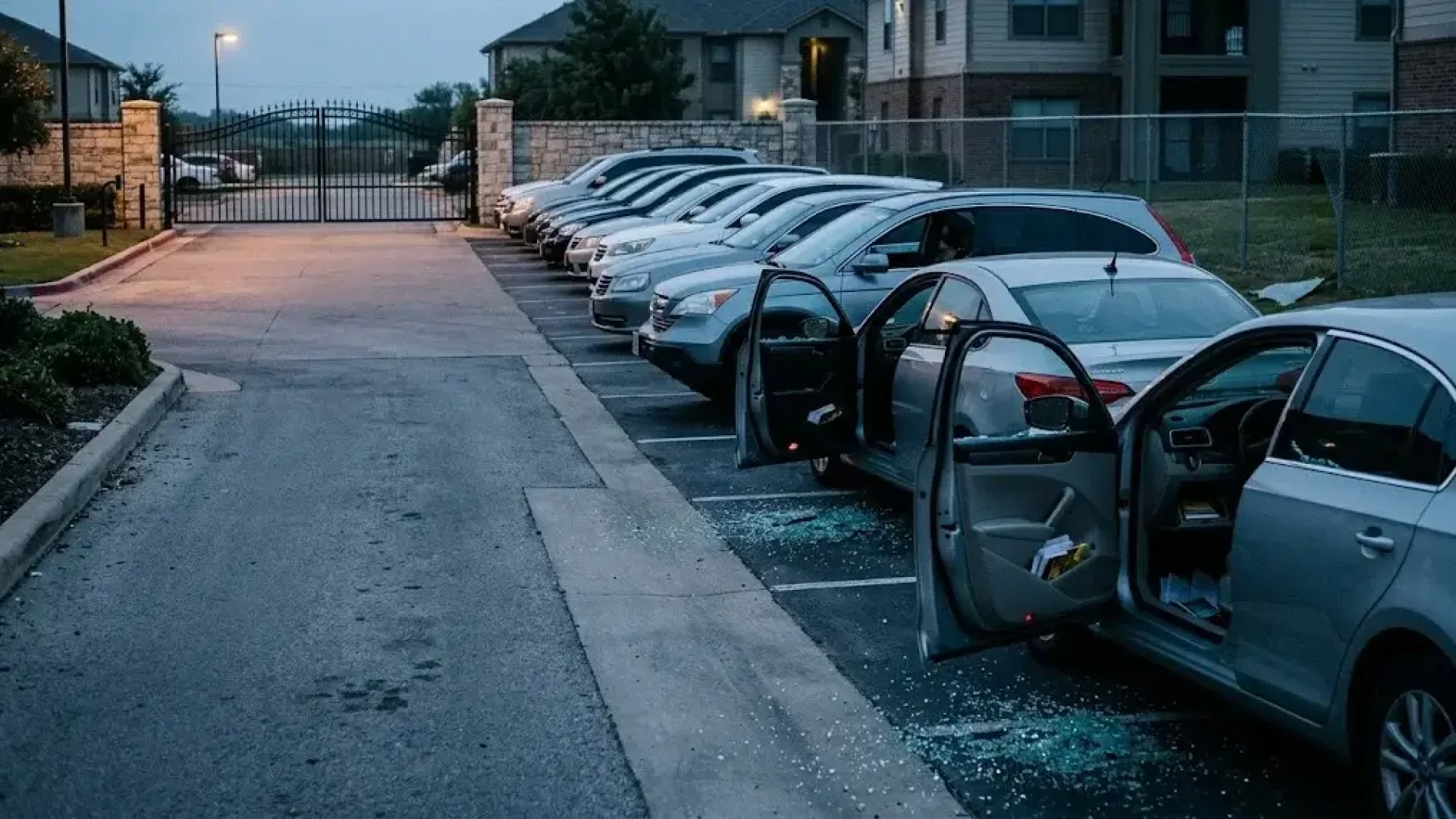
A gate controls who drives in through the front. It does nothing for the person who climbs the fence line.
In early September 2026, residents of a gated community in Northwest Miami-Dade woke up to find nearly 20 vehicles broken into overnight — windows smashed, glove boxes rifled, valuables gone, all inside a community that residents believed a gate made safe.
The gate didn’t stop anyone. It just controlled who drove in through the front, not who climbed the fence line.
WSVN’s coverage of the Northwest Miami-Dade incident documents residents discovering the damage the next morning, with the scale of the spree — nearly two dozen vehicles in a single community, in a single night — pointing to a coordinated run rather than isolated opportunistic theft.
The pattern lines up with a broader trend the multifamily industry is already tracking: the National Multifamily Housing Council’s most recent Risk and Insurance Survey found that property crime and liability claims are now the single largest category of insurance losses for mid-size apartment operators — ahead of weather events and slip-and-fall incidents combined.
Nearly 20 Vehicles, One Gate, One Night
A “gated” property creates a specific, dangerous assumption: that the perimeter is the security plan. Once that assumption sets in, everything behind the gate — parking areas, walkways, breezeways — tends to get lighter coverage than an ungated property would receive.
Typical exposure looks like:
- Perimeter fencing that stops driving traffic but not someone climbing over or walking around it
- Parking areas and structured garages that see disproportionately more theft than their share of a property’s overall footprint
- Overnight windows where a “gated” designation replaces active patrol rather than supplementing it
- A single coordinated run capable of hitting dozens of vehicles before anyone notices or responds
Auto theft and vehicle burglary have stayed elevated nationally since surging in 2022–2023, and apartment and gated-community parking areas continue to account for a disproportionate share of incidents relative to their share of total vehicle inventory.
Where a Gate Stops Doing Security Work
A gate is a access-control device, not a security program. Treating it as the whole plan leaves the property exposed to exactly this kind of overnight, multi-vehicle spree.
Modern multifamily and HOA security may rely on multiple layers of protection, including:
- Mobile patrol with randomized timing across parking areas and breezeways, not just the front gate
- Camera coverage extending into parking structures and along fence lines, not only entry points
- Licensed security personnel who understand a “gated” property still requires active coverage overnight
- Documented patrol logs formatted to meet insurance carrier and board reporting requirements
Each layer can reduce exposure.
But each layer also needs to account for the fact that a gate controls one thing — vehicle entry at one point — and nothing else about the property.
Budgeted as If the Gate Were the Guard
Most gated communities are budgeted and staffed as if the gate is doing security work that it was never designed to do.
That creates a gap between what residents believe a “gated community” promises and what the property’s actual security posture delivers.
The question is no longer simply whether the gate keeps unauthorized vehicles from driving in.
The more important question is whether anyone would notice — or stop — a person on foot working through a parking lot for an hour overnight.
What Property Managers and HOA Boards Should Review
1. Stop Treating the Gate as the Security Plan
A gate controls vehicle entry at one point. It does nothing for a person on foot, over a fence, or already inside from a prior visit.
2. Extend Patrol and Camera Coverage Into Parking Areas
Parking lots and structured garages carry a disproportionate share of theft risk relative to their footprint — coverage should reflect that, not treat them as an afterthought behind the gate.
3. Audit Perimeter Fencing, Not Just the Gate Itself
A single unmonitored fence line or gap can expose an entire community regardless of how well the vehicle gate itself is controlled.
4. Reassess Insurance Exposure Tied to Property Crime
Property crime and liability claims are now the leading loss category for mid-size apartment operators — a security posture that hasn’t kept pace with that shift is already behind on cost, not just risk.
A Plan That Ended at the Entrance
This wasn’t a security failure at the gate. It was a security plan that stopped at the gate.
Protecting a gated community or apartment complex requires treating the space behind the gate with the same seriousness as the entry point itself.
Operators and boards need to understand that residents’ sense of safety inside a gated property is only as real as the coverage that actually extends past the gate.
A More Complete Approach to Property Management Security
SPADE Security Services helps property managers and HOA boards build security programs around what a gate actually does — and, just as importantly, what it doesn’t — rather than treating “gated” as a finished security posture.
Our approach can combine intelligent surveillance, remote monitoring, licensed security personnel, patrol, visible deterrence, access management, and response based on the property’s specific exposure.
The objective is not to replace one security layer with another.
It is to make the layers work together.
Because protecting a gated community isn’t simply about who can drive through the front entrance.
It’s about making sure a person on foot can’t work through a parking lot for an hour without anyone noticing.
Nearly 20 vehicles were hit in one night behind a gate residents trusted to keep them safe. Your security strategy should account for what’s actually happening behind your gate, not just at it.
Schedule a Property Management Security Consultation
SPADE Security Services | Rocklin, CA | Veteran-owned | DVBE certified
Serving Placer, Sacramento, and El Dorado counties
Licensed by the California Bureau of Security and Investigative Services
PPO121804
What should an HOA or property manager do first after a multi-vehicle burglary spree?
Secure and review all available camera footage covering the full window of exposure, notify all affected residents, file a police report documenting the scope of the incident, and audit the specific perimeter point most likely used for entry.
Does a gated entrance mean a community is protected from this kind of crime?
Not on its own. A gate controls vehicle access at a single point — it does nothing to stop someone on foot from climbing a fence line or entering with a resident, and it provides no coverage for parking areas once someone is inside.
Why are apartment and gated-community parking areas disproportionately targeted?
Parking lots and structured garages tend to receive lighter security coverage than main entry points, while holding a concentrated, visible inventory of vehicles — making them an efficient target for a crew working multiple vehicles in one visit.
How can a gated community improve security without a full property redesign?
Start with the highest-exposure areas — parking lots, garages, and fence lines — and prioritize patrol timing, camera coverage, and lighting there before treating the front gate as a finished security plan.
SPADE Security Services | Rocklin, CA | Veteran-owned | DVBE certified | Serving Placer, Sacramento & El Dorado counties
Licensed by the California Bureau of Security and Investigative Services

