
A Customer's Catalytic Converter Was Stolen While Their Car Sat in a Dealership Service Bay. Congress Is Now Racing to Catch Up.
Author
Pranil Shankar
Post Date
August 31, 2026
Views
145
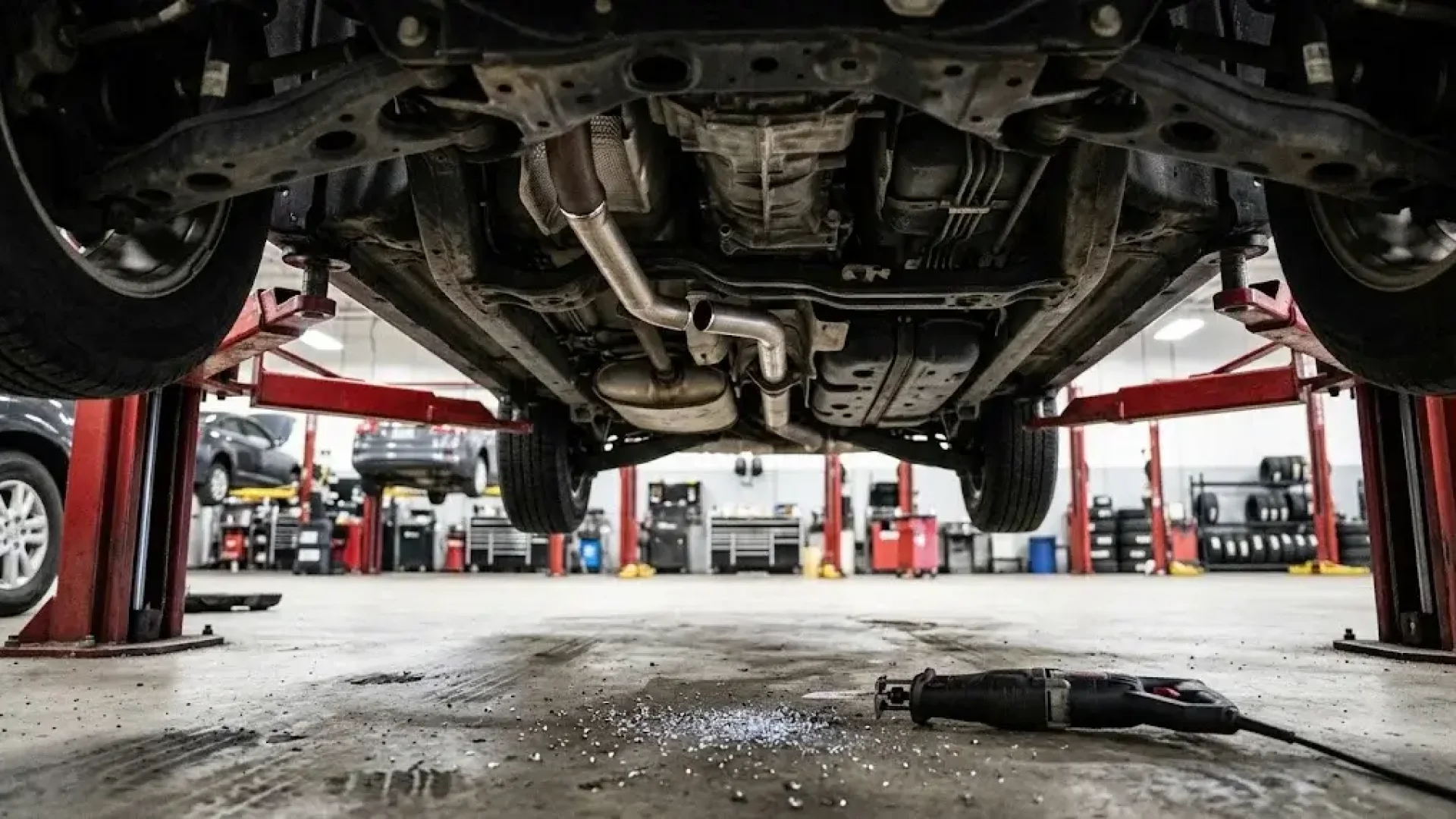
It Takes 90 Seconds to Steal a Catalytic Converter. Dealership Service Lots Are Discovering They’re Not Exempt From That Math.
In August 2026, a customer’s Honda CR-V had its catalytic converter stolen while the vehicle was parked in a dealership service lot in Frontenac, Missouri — waiting on a routine service appointment, not sitting unattended overnight in some unrelated parking lot.
The theft takes roughly 90 seconds. More than 137,000 catalytic converters were stolen nationwide last year, according to Carfax data, and 2025-2026 numbers show the trend climbing again after a brief dip — cities from St. Paul to Berkeley are logging fresh spikes.
St. Louis Magazine’s coverage of the Frontenac dealership incident details how service-lot vehicles — not just vehicles for sale — are now squarely in scope.
Ninety Seconds in a Service Lane
Dealership exposure concentrates in exactly the areas where vehicles sit unattended for hours: service bays, overflow lots, and fleet storage. A vehicle in for an oil change is just as exposed as one sitting on the sales lot overnight — arguably more so, since service-lot vehicles are rarely covered by the same overnight security routine as inventory.
In response, the National Automobile Dealers Association is pushing hard for the PART Act (Preventing Auto Recycling Thefts Act), which would require traceable stamped numbers on new catalytic converters and create a $7 million grant fund to help dealers mark converters on vehicles already on the road — the bill moved a step closer to law in February 2026 and remains active in the House.
Typical exposure looks like:
- Customer vehicles parked in service bays or overflow lots for hours during appointments
- Fleet and loaner vehicles stored without the same monitoring as sale inventory
- High-clearance trucks and SUVs, which offer thieves easier access underneath
- Early morning and lunch-hour windows when lots are fullest but staffing is thinnest
A Customer’s Car Is Inventory You Don’t Own
A service customer’s stolen catalytic converter isn’t just a parts loss — it’s a liability and trust problem. The vehicle was in the dealership’s custody when it happened.
Modern dealership security may rely on multiple layers of protection, including:
- Surveillance cameras covering service bays and overflow lots, not just the sales row
- Converter marking/etching programs for serviced vehicles
- Licensed security personnel and patrol extended to service areas
- Documented dwell-time tracking for vehicles in dealership custody
Each layer can reduce exposure.
But each layer also needs to be maintained, monitored, and considered as part of the dealership’s overall security strategy — including the areas that don’t typically get the same attention as the showroom floor.
Service Lots Sit Outside the Showroom’s Security
Sales-lot security and service-lot security are often treated as two different problems with two different standards, when the actual theft data shows service and overflow lots carry real, underprotected exposure.
That creates a gap between inventory protection and customer-vehicle protection.
The question is no longer simply whether the vehicles for sale are secure overnight.
The more important question is whether a customer’s vehicle is protected for the hours it sits in your custody during the day.
What Dealership Operators Should Review
1. Extend Coverage to the Service Lot, Not Just the Sales Lot
A customer’s vehicle in your custody deserves the same protection standard as inventory — during business hours, not just overnight.
2. Consider Converter Marking or Etching Programs
A marked converter is a documented deterrent and, per NADA’s push, may soon be incentivized by federal grant funding under the PART Act.
3. Audit Dwell Time in Unmonitored Zones
Know exactly how long a customer vehicle sits exposed between drop-off and the service bay, and close that window wherever possible.
4. Track the PART Act’s Progress
Federal movement here could shift what’s expected of dealers on converter security within the next reporting cycle — staying ahead of the requirement is easier than reacting to it.
Legislation Arrives After the Loss
The vehicles most exposed to this specific theft aren’t the ones for sale — they’re the ones a dealership already has a duty of care over.
Protecting a dealership requires more than securing the inventory on the display row.
Dealers need to understand where customer vehicles actually sit exposed during the service process, and how physical security extends into every part of the property — not just the parts customers see first.
A More Complete Approach to Dealership Security
SPADE Security Services helps dealerships build security programs around the actual conditions of their lots, service bays, and customer vehicle handling — not a generic sales-lot patrol.
Our approach can combine intelligent surveillance, remote monitoring, licensed security personnel, patrol, visible deterrence, access management, and response based on the dealership’s specific exposure.
The objective is not to replace one security layer with another.
It is to make the layers work together.
Because protecting a dealership isn’t simply about locking the sales lot at night.
It’s about making sure a customer’s vehicle is just as protected during a routine service appointment as your inventory is overnight.
A 90-second theft can happen in your own service lot. Your security strategy should account for the vehicles in your custody, not just the ones for sale.
Schedule a Dealership Security Consultation
SPADE Security Services | Rocklin, CA | Veteran-owned | DVBE certified
Serving Placer, Sacramento, and El Dorado counties
Licensed by the California Bureau of Security and Investigative Services
PPO121804
What should a dealership do first after a customer vehicle is targeted in the service lot?
Dealers should preserve available camera footage, file a police report, document the incident and vehicle details, and notify the customer and their insurance provider promptly.
They should also review dwell time and camera coverage for the specific area where the vehicle was parked.
Does having sales-lot security mean the whole dealership is protected?
No. Sales-lot security typically doesn’t extend the same monitoring standard to service bays, overflow lots, and fleet storage — exactly where recent catalytic converter theft has concentrated.
Why is the PART Act relevant to dealership security planning?
The proposed federal legislation would require traceable marking on new converters and fund marking programs for vehicles already on the road, which could shape what’s expected of dealers on converter security going forward.
How can dealerships reduce exposure without a full lot redesign?
Start with the highest-dwell-time zones — service bays and overflow lots — and prioritize camera coverage, marking programs, and patrol timing around those specific areas before considering a broader lot overhaul.
SPADE Security Services | Rocklin, CA | Veteran-owned | DVBE certified | Serving Placer, Sacramento & El Dorado counties
Licensed by the California Bureau of Security and Investigative Services

