
You're Paying Thousands a Month to Film Your Own Equipment Being Stolen
Author
Pranil Shankar
Post Date
July 20, 2026
Views
144
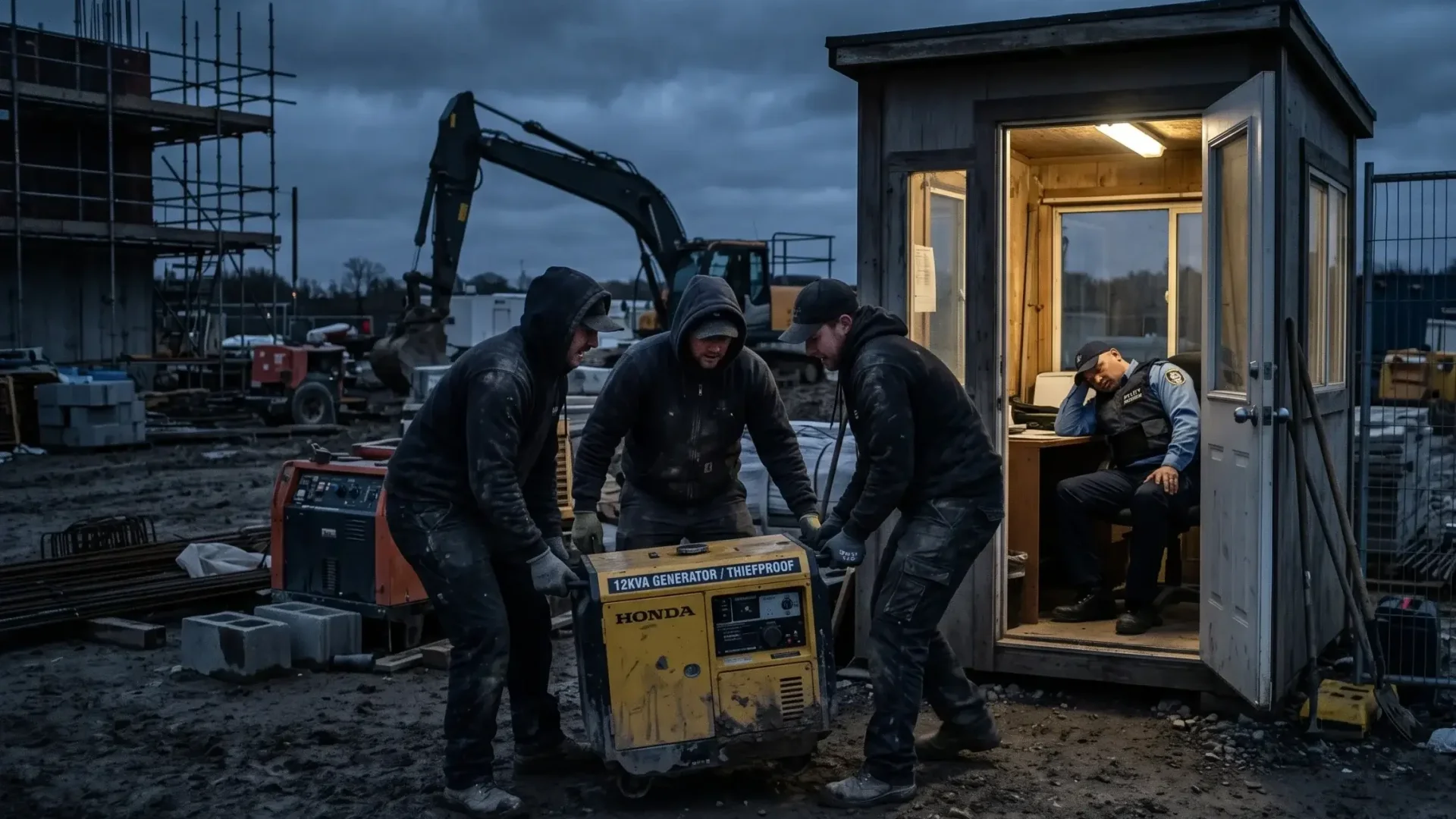
Every year, the U.S. construction industry spends record capital on perimeter fencing, heavy-duty padlocks, and ultra-high-definition surveillance technology—yet site managers still arrive on Monday mornings to a high-resolution recording of their own margins driving away.
The construction industry has never spent more on perimeter fencing, padlocks, and ultra-high-definition surveillance technology. Yet, despite this massive capital outlay, site managers keep arriving on Monday mornings to clipped wires, missing skid steers, and disrupted schedules. If the technology is better than ever, why do project margins still bleed out in the middle of the night?
The Losses Are Measured, Documented, and Staggering
The financial hemorrhage is measurable and well-documented. Construction site theft costs the U.S. industry between $300 million and $1 billion annually, and the average incident results in a direct loss of $30,000. Recovery offers little comfort: heavy equipment is recovered just 21% to 23% of the time, and for single items or hand tools the rate plummets below 7%. Meanwhile, copper wire theft — a crime that physically dismantles completed work — drains an additional $1 billion a year across all sectors.
Visibility Is Not Protection
The fundamental flaw in modern site planning is the false assumption that visibility equals protection. Owners install passive cameras and trust that the mere presence of a lens on a pole will deter organized theft rings. It doesn’t. Criminals know that passive cameras are nothing more than historical record-keepers. A fence delays an intruder for seconds; a camera simply captures their image as they load your assets onto a flatbed.
The Real Bill Arrives After the Equipment Is Gone
The true devastation of site theft is rarely the invoice for a replacement loader — it’s the cascading operational fallout. When critical equipment vanishes, crews are forced to stand idle, burning through labor budgets with zero productivity. Project managers scramble for expedited rental replacements at premium rates. Those delays inevitably push projects past their deadlines, triggering severe liquidated damages and contract penalties. And repeated claims destroy your risk profile, leading to steep insurance premium hikes and, occasionally, outright policy cancellation. You aren’t just losing machinery; you are losing your profit margin, your schedule, and your reputation.
The Crime Happens in the Gap Between Detection and Response
The core failure occurs in the crucial window between the moment a perimeter is breached and the moment someone intervenes. The technology successfully detected the intrusion — but nobody was watching, or the response was simply too slow. The industry average for security response is roughly 45 minutes, an eternity in which organized crews can easily strip an electrical panel and drive off. The gap between detection and action is where your project timeline is stolen. The crime isn’t unpreventable; it simply went unchallenged.
Stopping this bleeding requires closing the response gap. SPADE Security Services translates detection into immediate operational continuity — we don’t just watch, we intervene. Headquartered in Rocklin, CA and founded by Marine Corps combat veteran Pranil Shankar, SPADE is a veteran-owned, DVBE-certified firm that operates with military precision. We never subcontract or outsource our deployments; every operation is managed directly. While the industry accepts a 45-minute response delay, SPADE targets a sub-90-second response time, combining AI-powered surveillance, licensed officer patrols, drone coverage, and documented reporting into custom, property-specific programs. When a threat is detected, our integrated systems immediately verify the intrusion and initiate an active response, driving criminals off your site before the damage is done.
Because at the end of the day, passive cameras only record crime. Immediate, decisive response prevents it.
SPADE Security Services | Rocklin, CA | Veteran-owned | DVBE certified
Serving Placer, Sacramento, and El Dorado counties
Licensed by the California Bureau of Security and Investigative Services
PPO121804
What is the true cost of construction site theft?
Direct equipment losses range from $300 million to $1 billion annually. However, the indirect costs — idle labor, expedited rental fees, project delays, and the resulting contract penalties — often far exceed the replacement value of the stolen asset itself.
Why are equipment recovery rates so low?
Unlike passenger vehicles, heavy construction equipment lacks standardized identification numbers (VINs) and titles, making it incredibly difficult for law enforcement to track [12, 13]. That is why less than 25% of stolen machinery is ever recovered, and tool recovery rates sit below 7%.
Why is a fast response time critical for site protection?
Organized thieves can breach a fence, load equipment, or strip copper wiring in a matter of minutes. The industry-average response time of 45 minutes gives criminals ample time to complete the theft. A sub-90-second intervention interrupts the crime while it is happening, protecting your project schedule.
Do insurance companies care about proactive monitoring?
Yes. Insurers view construction sites as high-risk environments, and repeated claims lead to premium hikes and coverage drops. Conversely, demonstrating an active, rapid-response monitoring program can often qualify a business for premium discounts and protect its overall insurability.
SPADE Security Services | Rocklin, CA | Veteran-owned | DVBE certified | Serving Placer, Sacramento & El Dorado counties
Licensed by the California Bureau of Security and Investigative Services

