
- Industries
- Commercial Property ManagementParking lots, lobbies and common areas protected day and night.
- ConstructionJob site theft and after-hours break-ins, covered until the crew returns.
- Logistics and WarehouseGates, yards and loaded trailers watched and logged around the clock.
- AutomotiveLots, keys and inventory protected while the dealership is closed.
- EducationCampuses, doors and after-hours events kept safe.
- Health Care FacilityVisitor screening, patrols and monitoring for healthcare buildings.
- Services
- Security Guards & PatrolLicensed officers at the gate or on mobile patrol, with GPS-verified logs.
- Drone & RoboticsAerial and robotic patrols for large or hard-to-reach sites.
- Security TrailersMobile surveillance units that can be deployed within hours.
- Security CamerasCamera systems built to detect and report, not just record.
- Video MonitoringAI flags it, a human verifies it, and dispatch follows. 24/7.
- NotaryNotary public services for your business.
- Live ScanLive Scan fingerprinting for background checks.
- Resources
- About us
- Careers
Event Security in Sacramento: What Organizers Must Have in Place
Author
Pranil Shankar
Post Date
June 5, 2026
Views
228
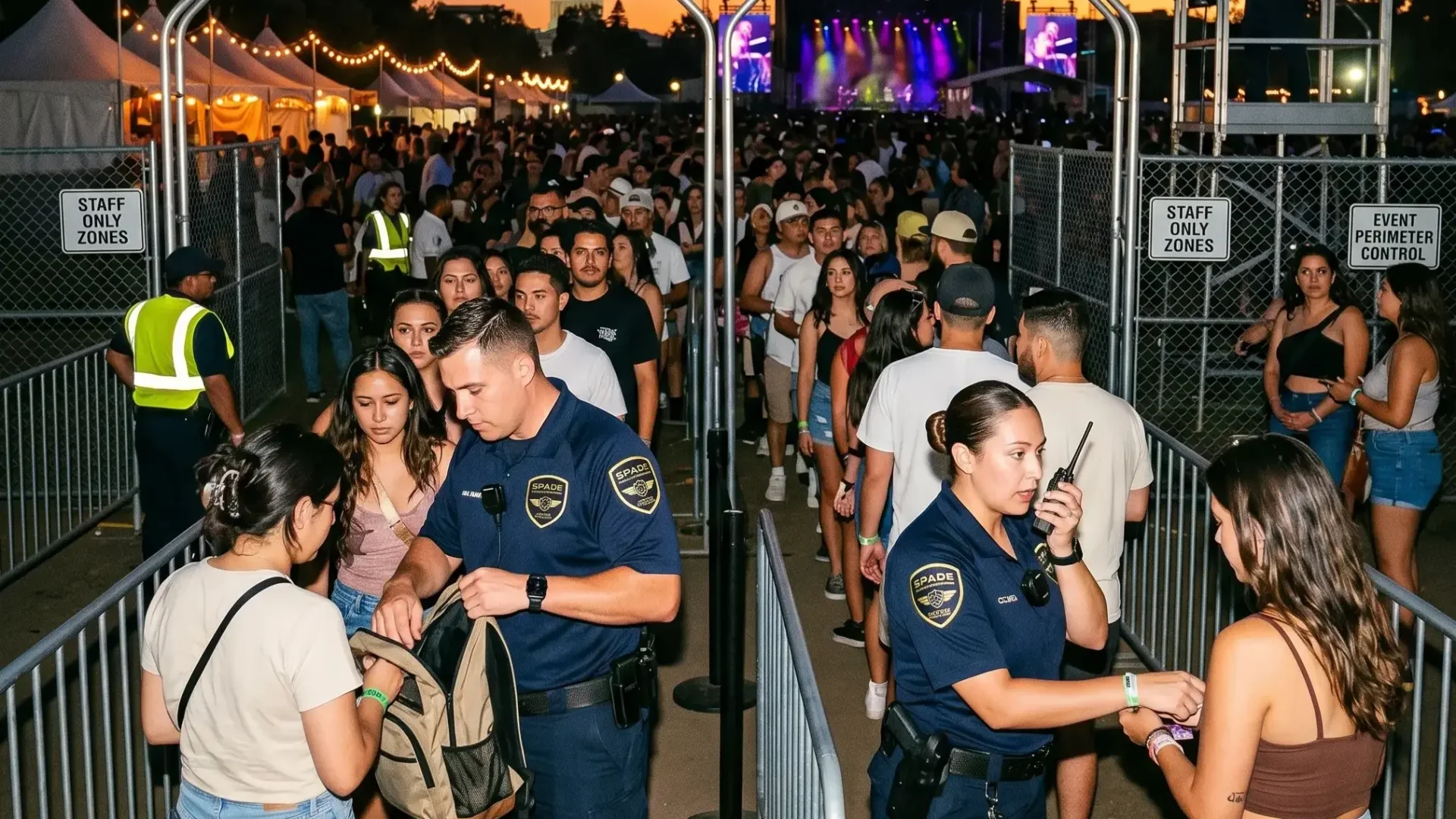
The production is done. The venue is booked. The catering is confirmed. You have been managing logistics for six weeks and you have a grip on every moving part except the one that matters most if something goes wrong: what happens when there is a situation that your staff is not equipped to handle.
Event security in Sacramento is the piece of event planning that most organizers treat as a checkbox item — find a company, confirm bodies are present at the door, move on. And for most events on most days, that approach produces no visible consequences. But when something goes wrong at an event — and the range of things that can go wrong is wider than most organizers want to consider — the question of whether you had a professional, licensed, well-briefed security operation in place becomes the central question in every conversation that follows.
This post covers what licensed event security in Sacramento actually looks like, what organizers and venues are legally and operationally responsible for, and what the difference is between a professional event security program and a warm body at the door.
What does professional event security in Sacramento include?
Professional event security is not a single service — it is a coordinated deployment of personnel, protocols, and communication systems built around the specific characteristics of your event. The right program depends on your event type, your venue, your expected attendance, and the specific risk profile of your audience and environment.
The core services that constitute professional event security for Sacramento-area events include the following.
- Credentialed access control at all entry points. Professional security manages the boundary between the public and your event — checking credentials, managing queues, identifying prohibited items, and handling the first layer of behavioral assessment for every person who enters. Access control done well is the most cost-effective security investment at any event because it prevents problems from entering rather than managing them once they are inside.
- Uniformed floor and perimeter coverage. Guards positioned inside the event space manage crowd behavior, respond to disturbances, support medical emergencies, and maintain the visible presence that deters escalation. Perimeter coverage outside the venue manages the environment where altercations most frequently begin — in the approach to entry, in smoking areas, and in the transition zones between the event and public access.
- Crowd management for high-capacity events. Events approaching or exceeding venue capacity require specific crowd management protocols — flow management, queue control, capacity monitoring at choke points, and communication between security positions to manage density before it becomes a safety issue. Professional crowd management is a specific competency distinct from general guard services.
- VIP and principal protection for events with designated secured areas or high-profile attendees. Backstage, green room, and designated access areas require their own security layer separate from general crowd management.
- Event-specific communication and command structure. Professional event security operates with a defined command structure — a lead security supervisor who has authority over all security personnel, a communication protocol between positions, and a clear escalation path to law enforcement when the situation requires it. An event with security personnel who have no shared communication system and no defined supervisor is not an event security program. It is a collection of individuals with no coordination capability.
What are the legal responsibilities of an event organizer for attendee safety in California?
California premises liability law applies to event organizers and venues. When an attendee is harmed at an event — whether by another attendee, by a criminal act, or by conditions the organizer created or failed to address — the organizer’s liability is evaluated against the standard of reasonable care.
That standard requires event organizers to take reasonable steps to prevent foreseeable harm. For a public-facing event in Sacramento with expected attendance of more than a few dozen people, reasonable care includes a licensed security provider, a written security plan that matches the size and risk profile of the event, and documented evidence that the plan was implemented.
The foreseeability standard is the relevant test. If your event type, your venue, your expected audience, or the location’s incident history creates a foreseeable risk of crowd disturbance, unauthorized access, or personal safety incidents, and you did not have professional security in place, that gap is the central fact in any subsequent liability claim.
The inverse is equally important: an organizer who can demonstrate that they engaged a licensed security company, briefed that company on event-specific risks, and deployed a professional security program appropriate to the event’s scale is in a fundamentally stronger legal position if something occurs despite those measures.
How far in advance should I book event security in Sacramento?
The lead time question matters more than most organizers realize, and the consequences of leaving it too late are significant.
For large events — those with attendance over 500, those with alcohol service, or those at high-profile venues in Sacramento — professional security staffing should be confirmed at minimum four to six weeks in advance. This lead time allows the security provider to staff appropriately, conduct a pre-event site walk with the organizer, develop event-specific briefing materials for deployed personnel, and coordinate any required communication with local law enforcement for events that may require law enforcement liaison.
For corporate events, private gatherings, and mid-size public events, two to four weeks of lead time is the minimum for a well-organized deployment. Last-minute requests — within a week of the event — typically limit the security company’s ability to assign experienced personnel who are familiar with the venue and briefed on event-specific requirements.
The pre-event site walk is the most important element that last-minute bookings eliminate. A security company that has walked your venue, mapped your entry and exit points, identified your crowd flow choke points, and briefed their personnel specifically on your event layout is a fundamentally different operation than a crew that arrives the day of.
What questions should I ask an event security company in Sacramento before booking?
Ask whether the company has experience with events of your specific type and scale — not just general guard experience. Ask how they staff events, whether they can commit to named supervisors, and what their contingency is if a deployed officer does not show. Ask what their pre-event process looks like — do they conduct a site walk, develop event-specific briefing materials, and maintain communication between positions during the event? Ask whether they carry event-specific liability insurance and can provide certificates naming your organization as additional insured.
A professional event security company will have specific answers for every one of these questions. A company that responds in generalities is showing you exactly what your event coverage will look like.
Why Sacramento event organizers choose SPADE Security Services
- SPADE Security Services is a veteran-owned, DVBE-certified physical security company headquartered in Rocklin, California. We provide event security for corporate events, public gatherings, community functions, and private venues across Sacramento County and Placer County.
- Our event security programs begin with a pre-event site walk. We map your entry points, identify your crowd flow vulnerabilities, develop event-specific briefing materials for our deployed personnel, and establish a communication protocol between positions and a command structure before the first attendee arrives.
- Every guard we deploy holds a current BSIS registration card. We carry event-specific liability insurance and provide certificates naming your organization as additional insured as a standard part of every event contract.
- We offer a complimentary consultation for Sacramento-area event organizers. Tell us your event type, your expected attendance, your venue, and your date — and we will give you a clear picture of what professional event security looks like for your specific situation.
Contact SPADE Security Services to discuss your event: spadesecurityservices.com | Rocklin, CA | Serving Placer, Sacramento, and El Dorado counties.
Frequently asked questions: Event Security in Sacramento
How many security guards do I need for my Sacramento event?
Guard-to-attendee ratios for events in Sacramento depend on the event type, venue layout, alcohol service, and expected attendee demographics. A general guideline for public events with alcohol service starts at one guard per 50 to 75 attendees as a floor — but events with specific risk factors, crowd management requirements, or VIP access requirements will require higher ratios. The most reliable way to determine appropriate staffing is a pre-event consultation with a licensed security provider who can assess your specific venue and event characteristics. SPADE provides staffing recommendations based on a site walk and event brief, not a generic formula.
Does event security in Sacramento need to be licensed through BSIS?
Yes. Security guards deployed at events in California must hold current BSIS guard registration cards, and the security company providing those guards must hold a current BSIS PPO license. Event organizers should verify both before booking. An event where security personnel are not BSIS-licensed exposes the organizer to significant liability if an incident occurs and the security provider’s credentials cannot be established. SPADE guards are BSIS-registered and our PPO license number (PPO121804) is verifiable at any time.
What is the difference between a bouncer and a licensed security guard at a Sacramento event?
A bouncer is an informal term with no regulatory definition in California. A licensed security guard is a person who holds a current BSIS guard registration card, has completed required training, and operates under the license of a BSIS-licensed Private Patrol Operator. The distinction matters legally — an unlicensed individual managing access or responding to incidents at an event creates liability exposure for the event organizer that a licensed guard does not. For any event where access control, crowd management, or incident response is required, the personnel performing those functions should be BSIS-licensed security guards.
Can SPADE Security Services provide event security for nonprofit or community events in Sacramento?
Yes. SPADE provides event security for nonprofit organizations, community associations, school events, church gatherings, and public-facing community functions across Sacramento County and Placer County. We understand that nonprofit and community event budgets are different from corporate event budgets, and we develop coverage plans that prioritize the highest-risk elements of the event within available resources. Contact us to discuss your specific event and we will design a program that fits your requirements.
What happens if a security incident occurs at my Sacramento event despite having security in place?
A properly briefed professional security team responds to incidents according to a pre-established escalation protocol — de-escalation, medical response coordination, law enforcement notification, and evidence documentation. SPADE generates written incident reports for every security event at client engagements, formatted to support both law enforcement reporting and insurance claims documentation. An event organizer who has a professional security company in place, a written incident report from the responding guards, and documented evidence of a pre-event security plan is in the strongest possible position for any subsequent claim or inquiry.
SPADE Security Services | Rocklin, CA | Veteran-owned | DVBE certified | Serving Placer, Sacramento & El Dorado counties
Licensed by the California Bureau of Security and Investigative Services


THE ACE IN SECURITY
Menu
Stay Ahead of Security Threats
Get Spade Security’s latest insights, incident breakdowns and company news in your inbox — only when we publish.
Text size: 100%