
Downtown Sacramento Construction Security: Limited Space, Unlimited Protection
Author
Pranil Shankar
Post Date
May 29, 2025
Views
159
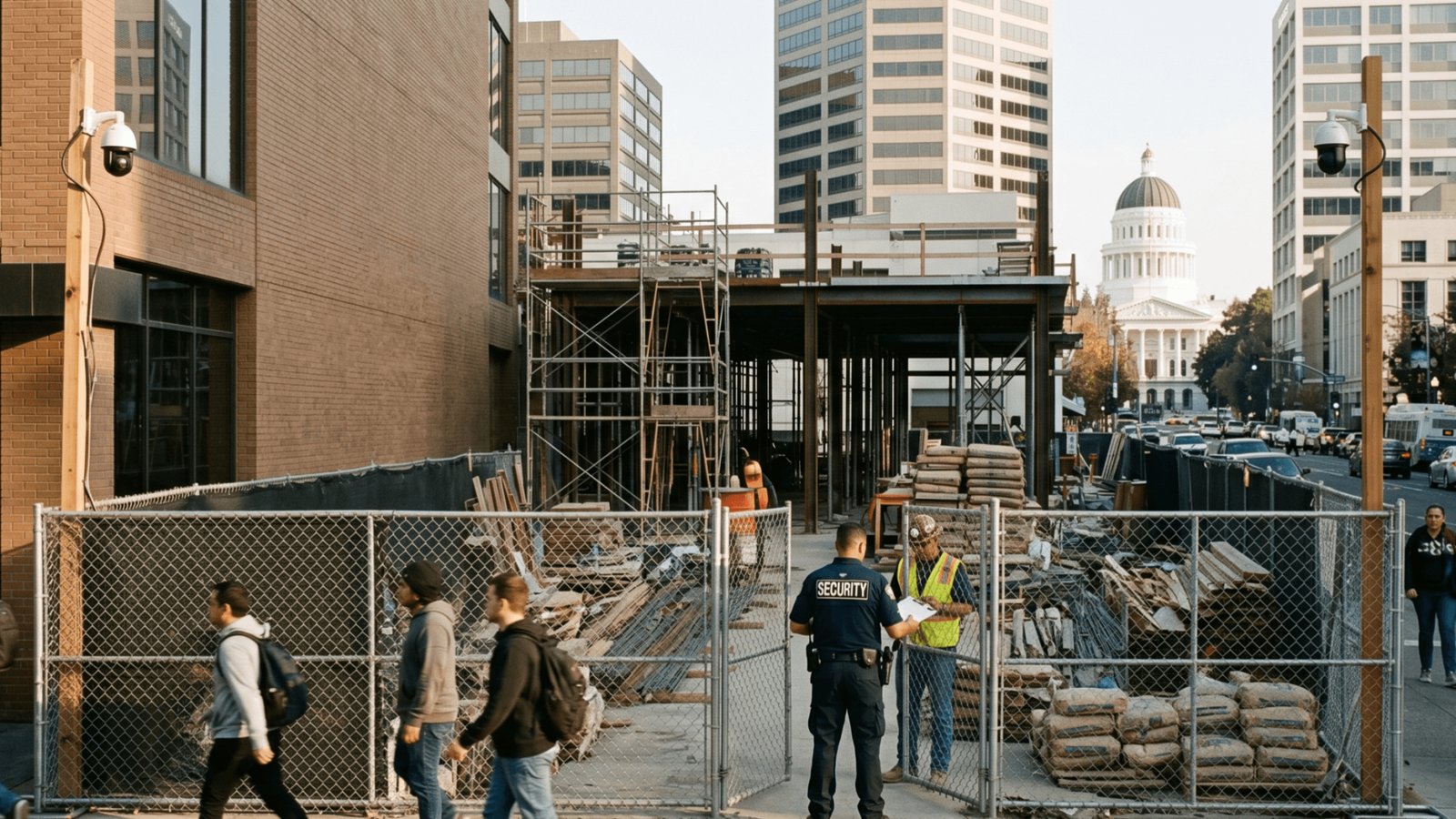
Downtown Sacramento construction is a different problem than a suburban job site in Rocklin or Lincoln. You don’t have a perimeter fence backed by fifty feet of open yard. You don’t have a dedicated guard shack with sightlines across the entire site. You have a city block — or a portion of one — surrounded by active streets, adjacent businesses, public foot traffic at all hours, and a project schedule that doesn’t have room for the delays that a security incident creates.
The conventional response to construction site security in a constrained urban environment is to put a guard at the gate and hope the camera system catches whatever the guard misses. In 2026, that model is not sufficient — and the contractors and project managers who have learned that lesson have learned it the hard way.
The good news is that the security technology available to downtown Sacramento construction projects has advanced significantly. AI-powered camera systems, integrated monitoring platforms, and mobile patrol coordination tools have fundamentally changed what is possible on a space-constrained urban job site. The question is no longer whether you can detect a problem. The question is what happens in the sixty seconds after the camera sees it.
Why downtown Sacramento construction sites face unique security challenges
Urban infill and downtown construction projects in Sacramento operate under constraints that suburban sites simply do not face. Understanding those constraints is the starting point for building a security program that actually works in a compressed environment.
- Physical perimeter limitations. A downtown Sacramento job site may have one or two access points, shared loading zones with adjacent properties, and perimeter fencing that runs directly to the edge of a public sidewalk. There is no buffer zone. Unauthorized access, trespassing, and theft can occur within feet of a public right-of-way where anyone has legal standing to be.
- 24-hour public access to the surrounding environment. Suburban construction sites go quiet at night. Downtown Sacramento does not. Foot traffic, vehicle traffic, and the activity patterns of urban nightlife mean that a downtown job site has potential access attempts at every hour — not just during the predictable overnight window that suburban patrol schedules are built around.
- High-value equipment in confined staging. When you cannot spread equipment across a large yard, you concentrate it. A downtown Sacramento site with a tower crane, concrete pumping equipment, and a materials storage area compressed into a half-block footprint has a density of high-value assets that makes it an attractive target precisely because everything is close together and accessible.
- PPE compliance and contractor accountability in active work zones. Urban construction sites adjacent to the public often face heightened scrutiny from city inspectors, OSHA, and the adjacent business community. A worker without the correct PPE in a visible downtown location is not just a safety liability — it is a reputational and regulatory exposure that lands on the superintendent’s desk immediately.
- Neighboring property and business liability. When your site shares a wall, a sidewalk, or an access point with an operating business, your security exposure extends to their property. An incident that originates on your site and affects an adjacent business creates a liability chain that suburban projects rarely face.
Why detection alone is not a security program
This is the gap that most downtown Sacramento construction security programs fall into — and it is worth being direct about why it matters.
AI camera systems in 2026 are genuinely impressive. They can detect a person crossing a perimeter line at 2 a.m. They can identify a vehicle that has been parked in a restricted zone for more than thirty minutes. They can flag a worker in an active zone who is not wearing a hard hat, high-visibility vest, or the correct footwear for the environment. The detection capability is real, it is accurate, and it is available at a price point that makes sense for most commercial construction projects.
Detection is not the problem. What happens after the camera sees something is the problem.
Most camera monitoring solutions — including the majority of remote monitoring services available to Sacramento contractors today — are built around one response capability: they call someone. They send an alert to a phone. They notify a monitoring center that generates a verbal warning over a speaker system. They email a report to the project manager who reads it at 7 a.m.
None of those responses stop anything that is happening right now.
The critical capability that separates an integrated security program from a camera system with a monitoring subscription is the ability to dispatch a physical response — a patrol officer on the ground, at your site, within minutes of a detection event — and to escalate directly to law enforcement when the situation requires it. That capability requires a security company whose monitoring infrastructure is connected to a patrol operation, not just a call center.
When an AI camera on your downtown Sacramento job site detects an unauthorized person in your materials staging area at 1 a.m., the relevant question is not whether your system saw them. It is whether anyone with the authority and physical capability to respond is going to be there before they leave with your copper wire, your power tools, or your irreplaceable project documentation.
How integrated technology makes your guard force a force multiplier
The right frame for understanding integrated security on a downtown Sacramento construction site is not technology replacing guards. It is technology making every guard dramatically more effective.
A single patrol officer covering a downtown Sacramento job site without technology support can see what is in front of them. They can be in one place at a time. They can respond to what they directly observe. Their coverage is limited by physics — where they are standing, where they are looking, and how fast they can move.
The same patrol officer supported by an AI camera network, a live monitoring integration, and a direct dispatch connection to a monitoring center can effectively cover the entire site simultaneously. The cameras provide 360-degree, continuous observation. The AI detection layer filters out irrelevant movement — wind, shadows, normal street activity — and flags genuine anomalies for human review. The monitoring center provides the officer with real-time information about what is happening on parts of the site they are not currently watching. And when a detection event occurs, the officer is dispatched to the specific location with specific information about what the camera saw — not a general alert that something might be happening somewhere.
That integration is the force multiplier. One officer with full situational awareness across an entire site is more effective than three officers without it. And the monitoring center that can dispatch that officer and simultaneously notify law enforcement with camera footage already in hand is a fundamentally different capability than a camera system that sends an email.
AI cameras for PPE compliance monitoring. Beyond security, AI camera systems on downtown Sacramento construction sites are increasingly used for worker safety compliance monitoring. A camera system that can detect a worker in an active zone without the correct PPE — and alert a superintendent in real time, not at the end of a shift review — closes a compliance gap that manual site walks cannot fully address. For projects with OSHA scrutiny or city inspector attention, documented AI-assisted compliance monitoring is both a safety tool and a liability management instrument.
Integrated dispatch with law enforcement coordination. The distinction between a monitoring service that notifies law enforcement and one that coordinates with law enforcement matters significantly in a downtown Sacramento environment where response times and information quality affect outcomes. A monitoring center with an established law enforcement coordination protocol — one that can provide responding officers with live camera feeds, site access information, and suspect description in real time — produces a meaningfully different outcome than a call that says “there might be someone on the site at Fifth and K.”
What an integrated construction security program looks like for a downtown Sacramento project
Building the right integrated security program for a downtown Sacramento construction site starts with an honest assessment of the specific constraints and risk profile of the project — not a template applied from a suburban job site playbook.
The components that consistently produce the best outcomes for urban Sacramento construction security include the following.
AI camera coverage mapped to your specific site geometry. Camera placement on a downtown site needs to account for your actual perimeter, your access points, your materials staging areas, and the public-facing elements of your site that create both exposure and observation opportunities. A site-specific camera deployment plan — not a standard four-corner installation — is the foundation of effective detection coverage.
Live monitoring with dispatch capability. Your camera system needs to be connected to a monitoring center that can dispatch a physical patrol response within minutes of a detection event. If your monitoring provider cannot tell you exactly how long it takes to get a patrol officer to your site after a camera alert, that is your answer about their dispatch capability.
Mobile patrol with site-specific briefing. Patrol officers covering your downtown Sacramento site need to know your site — your access points, your high-value staging areas, your neighbor relationships, and the specific PPE and access requirements for your project. A patrol officer who arrives without that briefing is covering a generic construction site, not yours.
Direct law enforcement coordination protocol. Your security provider should have an established protocol for law enforcement notification that includes who calls, what information they provide, and how camera footage is made available to responding officers. That protocol should exist before an incident occurs — not be improvised during one.
Superintendent-level reporting. The project manager or superintendent accountable for site security should receive patrol logs, detection event summaries, and PPE compliance reports on a schedule that allows them to act on the information — not just archive it.
Why downtown Sacramento contractors choose SPADE Security Services
SPADE Security Services is a veteran-owned, DVBE-certified physical security company headquartered in Rocklin, California. We provide integrated construction site security for urban and downtown Sacramento projects — combining AI camera monitoring, live dispatch-capable monitoring, mobile patrol, and direct law enforcement coordination into a single, connected security program.
We understand that downtown Sacramento construction security is not a suburban problem with a smaller perimeter. It is a fundamentally different operational environment that requires a security program built around your specific site geometry, your project schedule, and the urban risk factors that suburban job site templates do not address.
Our monitoring infrastructure is connected to our patrol operation. When a camera on your site detects an event, we can dispatch a patrol officer and notify law enforcement simultaneously — with footage, site information, and a live feed already in hand. That capability is not available from a camera company with a monitoring subscription. It requires a security provider whose detection and response capabilities are integrated by design.
We offer a complimentary security assessment for downtown Sacramento construction projects. We walk your site, map your specific perimeter constraints and high-value staging areas, and give you a written integrated security program recommendation your project team can evaluate and implement before your next phase begins.
Contact SPADE Security Services to schedule your site assessment: spadesecurityservices.com | Rocklin, CA | Serving Placer, Sacramento, and El Dorado counties.
Frequently asked questions: integrated construction security in downtown Sacramento
Can AI cameras replace security guards on a downtown Sacramento construction site?
No — and understanding why matters for building an effective security program. AI cameras solve the detection problem with impressive accuracy. They can identify unauthorized personnel, flag PPE violations, and monitor your entire perimeter simultaneously. What they cannot do is physically respond to what they detect. The value of integrated security is that AI cameras make your guard force dramatically more effective — giving a single officer full situational awareness across the entire site and directing them to the exact location of a detection event in real time. Detection without response capability is not a security program. It is a documentation system.
What can AI cameras detect on a construction site that standard cameras cannot?
AI-powered cameras on construction sites in Sacramento are currently deployed for several detection capabilities that standard cameras cannot provide without human review of recorded footage. These include real-time perimeter intrusion detection that distinguishes between a person crossing a line and irrelevant movement like wind or shadows, vehicle detection in restricted zones with dwell-time alerts, PPE compliance monitoring that identifies workers without hard hats, high-visibility vests, or appropriate footwear in active zones, and after-hours activity detection that triggers immediate alerts rather than generating footage reviewed the next morning. The operational value is that these detections happen in real time — enabling a response while the event is occurring, not after it is over.
What happens when a monitoring center detects an intrusion on my Sacramento construction site at 2 a.m.?
The answer to this question is the most important thing you can ask any security provider before signing a monitoring contract. A monitoring center with dispatch capability will simultaneously alert the on-site or nearest patrol officer with the specific location and camera feed of the detection event, issue a verbal warning over the site speaker system if equipped, and notify law enforcement with site information and live footage access if the situation warrants. A monitoring center without dispatch capability will call a phone number and generate an alert. The difference between those two responses, at 2 a.m. on a downtown Sacramento job site, is the difference between a recovered situation and a completed theft.
How does SPADE Security Services coordinate with Sacramento Police Department during a construction site incident?
SPADE maintains established law enforcement coordination protocols for active incident response at construction sites in Sacramento. When a detection event escalates to a law enforcement notification, our monitoring center provides Sacramento PD with site address and access information, a description of the detected activity and individuals involved, live camera feed access where technically available, and a direct contact for the patrol officer already responding to the site. This coordination protocol exists before any incident occurs — it is built into our security program design for every downtown Sacramento project we serve, not improvised during an emergency.
Does SPADE Security Services offer PPE compliance monitoring as part of a construction site security program?
Yes. For downtown Sacramento construction projects where OSHA compliance, city inspector scrutiny, or project owner requirements make PPE monitoring a priority, SPADE integrates AI camera-based PPE detection into our site security program. Detection events are logged with timestamps and camera reference for compliance documentation, and real-time alerts can be configured to notify the superintendent or safety officer directly when a violation is detected in an active zone. This capability functions as both a safety tool and a liability management instrument — providing documented evidence of active compliance monitoring that a post-incident review or regulatory inquiry can reference.
SPADE Security Services | Rocklin, CA | Veteran-owned | DVBE certified | Serving Placer, Sacramento & El Dorado counties
Licensed by the California Bureau of Security and Investigative Services

