
7 Hidden Costs Bleeding Your Construction Budget Dry
Author
Pranil Shankar
Post Date
July 8, 2026
Views
227
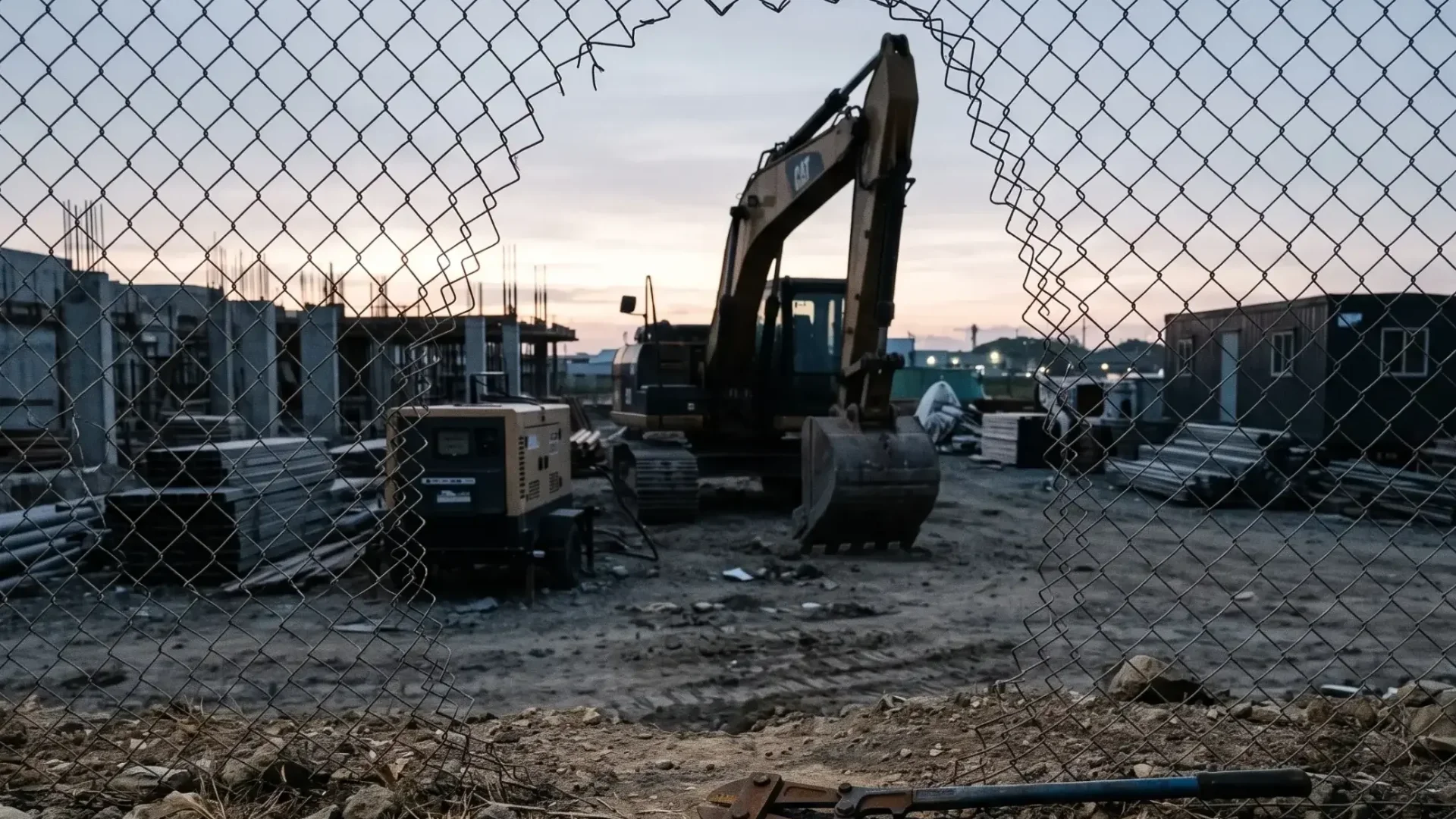
Your Job Site Isn’t Losing Money to Theft. It’s Losing Money to a Lack of Response.
For CEOs and construction business owners, site security is often treated as a line-item expense — something to minimize, not invest in. But when heavy machinery, raw materials, or power tools disappear overnight, the financial hemorrhage extends far beyond the replacement value of stolen assets. Construction equipment theft costs the U.S. industry an estimated $300 million to $1 billion annually. Worse yet, fewer than 25% of stolen machines are ever recovered.
Factor in downtime, insurance penalties, and operational friction, and the true cost of theft becomes a serious business liability. Every dollar bled out through these seven channels traces back to the same root cause: nobody was positioned to respond before the loss was already complete.
Here are the 7 distinct ways construction sites lose money to theft, and what actually closes the gap.
1. Direct Equipment Replacement Costs
The immediate financial hit of replacing high-value assets.
When a skid steer, loader, or excavator vanishes, the direct loss is devastating. The average financial loss from a single equipment theft incident ranges from $6,000 to $30,000 depending on the asset. Because many heavy machines use universal ignition keys, physical theft is alarmingly easy. Once stolen, rapid resale and altered serial numbers mean most companies are forced to purchase full replacements entirely out of pocket.
2. Soaring Raw Material Expenses
Buying the same expensive materials twice in an inflated market.
Raw materials are prime targets for opportunistic thieves and organized rings alike. The U.S. Department of Energy estimates that copper theft costs U.S. businesses around $1 billion a year. Lumber and steel have experienced unprecedented price volatility — lumber prices alone spiked over 300% since 2020. When thieves hit drop-off zones or laydown areas over the weekend, contractors are forced to re-order at premium spot prices just to keep the project moving.
3. Collateral Property Damage
The destruction left behind by careless criminals.
Thieves are rarely delicate when extracting what they want. Material stripping — particularly copper wiring and plumbing fixtures — causes massive collateral damage to completed work. It is common for a $5,000 to $10,000 copper theft to result in $50,000 or more in damage to drywall, electrical panels, and HVAC systems. This destructive pattern requires costly remediation labor and structural inspections before the project can even resume.
4. Project Delays and Liquidated Damages
The compounding cost of missing your contract deadlines.
Time is money, and theft steals both. Replacing stolen equipment or re-ordering stripped copper can add days, weeks, or even months to a project timeline due to supply chain constraints. Project delays caused by theft can cost an average of $10,000 per day in idle time and extended overhead. Missing contract deadlines can also trigger severe liquidated damages clauses, legally obligating you to pay thousands of dollars in penalties for every day the project runs over.
5. Insurance Premium Hikes and Unmet Deductibles
The long-term financial bleed of filing theft claims.
Relying on insurance to cover theft is a costly strategy. Many stolen tools and small materials fall below the insurance deductible, forcing companies to absorb the entire loss out of pocket. Filing repeated theft claims signals to insurers that your site is a high-risk environment — a label that routinely results in premium increases of 20% to 40% at your next renewal, directly eroding your profit margins on future bids.
6. Emergency Rental Fees
The stopgap costs to keep crews working.
When a vital piece of machinery like a backhoe or generator is stolen, work cannot simply halt while a purchased replacement ships. Contractors are forced into the emergency rental market. Depending on equipment type and supply chain availability, you could be paying exorbitant daily or weekly rental fees for 2 to 8 weeks while waiting for permanent replacements to arrive.
7. Wasted Labor and Administrative Burden
Paying for downtime and red tape instead of productivity.
Theft introduces immense friction into your daily operations. You lose money paying idle crews who cannot work without their tools or machinery. Site managers must redirect their time away from project execution to file police reports, coordinate with insurance adjusters, document missing serial numbers, and source replacement gear.
The SPADE Solution: Stopping the Bleed Before It Starts
Every one of these seven losses shares the same root cause — a response gap between when a theft begins and when someone actually shows up. A fence doesn’t close that gap. A camera doesn’t close it either; it just gives you better footage of a loss that already happened. SPADE closes it by targeting a sub-90-second response to verified threats, compared to the industry average of roughly 45 minutes — the exact window most of these seven losses depend on to happen at all.
SPADE does not subcontract or outsource any part of that response. Every officer, every patrol, every dispatch is managed directly, which is what makes a sub-90-second commitment operationally real instead of a number in a sales deck. Programs are built around each site specifically — equipment storage, material laydown areas, access points — combining AI-powered surveillance, licensed officer patrols, drone coverage, and documented incident reporting into one system instead of a patchwork of disconnected tools.
The difference this makes to your bottom line is direct: a theft interrupted in progress never becomes a $6,000–$30,000 equipment loss, a $50,000 collateral damage bill, a $10,000-a-day project delay, or a 20–40% premium hike at renewal. Every one of the seven costs above only materializes because the theft was allowed to finish. Stopping it before it finishes is the actual fix — not a better fence, not a better lock, a faster response.
In 2026, relying on chain-link fences and padlocks is a guaranteed way to lose money. Real protection requires an active, integrated approach. SPADE doesn’t just record crimes happening — SPADE actively intervenes to stop them.
Stop absorbing theft as a “cost of doing business.” Protect your bottom line today.
Schedule a Free Security Assessment
SPADE Security Services | Rocklin, CA | Veteran-owned | DVBE certified
Serving Placer, Sacramento, and El Dorado counties
Licensed by the California Bureau of Security and Investigative Services
PPO121804
When do most construction site thefts occur?
The vast majority of construction thefts are after-hours crimes. Over 80% of equipment thefts take place on weekends or public holidays when sites are unattended, and approximately 70% occur under the cover of darkness between 6 PM and 6 AM.
What is the recovery rate for stolen construction equipment?
The recovery rate is notoriously low. Across all heavy equipment categories, fewer than 25% of stolen machines are ever recovered. For smaller items like individual tools or raw materials, that rate drops to less than 7%.
How does theft impact project insurance costs?
Filing a theft claim for stolen equipment typically results in a 20% to 40% increase in your insurance premiums at the next renewal cycle. Additionally, many small thefts fall under the policy deductible, meaning contractors pay the replacement costs entirely out of pocket.
What items are targeted most frequently by thieves?
Thieves heavily target towable equipment (like generators and compressors), wheeled loaders, and excavators because of their high resale value. Raw materials — particularly copper wiring — are also major targets, costing U.S. businesses an estimated $1 billion annually.
How is SPADE’s response different from a standard security company?
SPADE targets a sub-90-second response to verified threats, compared to the industry average of roughly 45 minutes. This is achieved through directly managed patrol, monitoring, and dispatch infrastructure — no subcontracting — combined with AI-powered surveillance, drone coverage, and documented reporting built around each site’s specific layout and risk profile.
SPADE Security Services | Rocklin, CA | Veteran-owned | DVBE certified | Serving Placer, Sacramento & El Dorado counties
Licensed by the California Bureau of Security and Investigative Services


THE ACE IN SECURITY
Menu
Stay Ahead of Security Threats
Get Spade Security’s latest insights, incident breakdowns and company news in your inbox — only when we publish.
Text size: 100%