
The U.S. Event Security Market Is Racing Toward $3.5 Billion — Here's What That Growth Says About the Risk Facing Every Venue
Author
Pranil Shankar
Post Date
July 15, 2026
Views
113
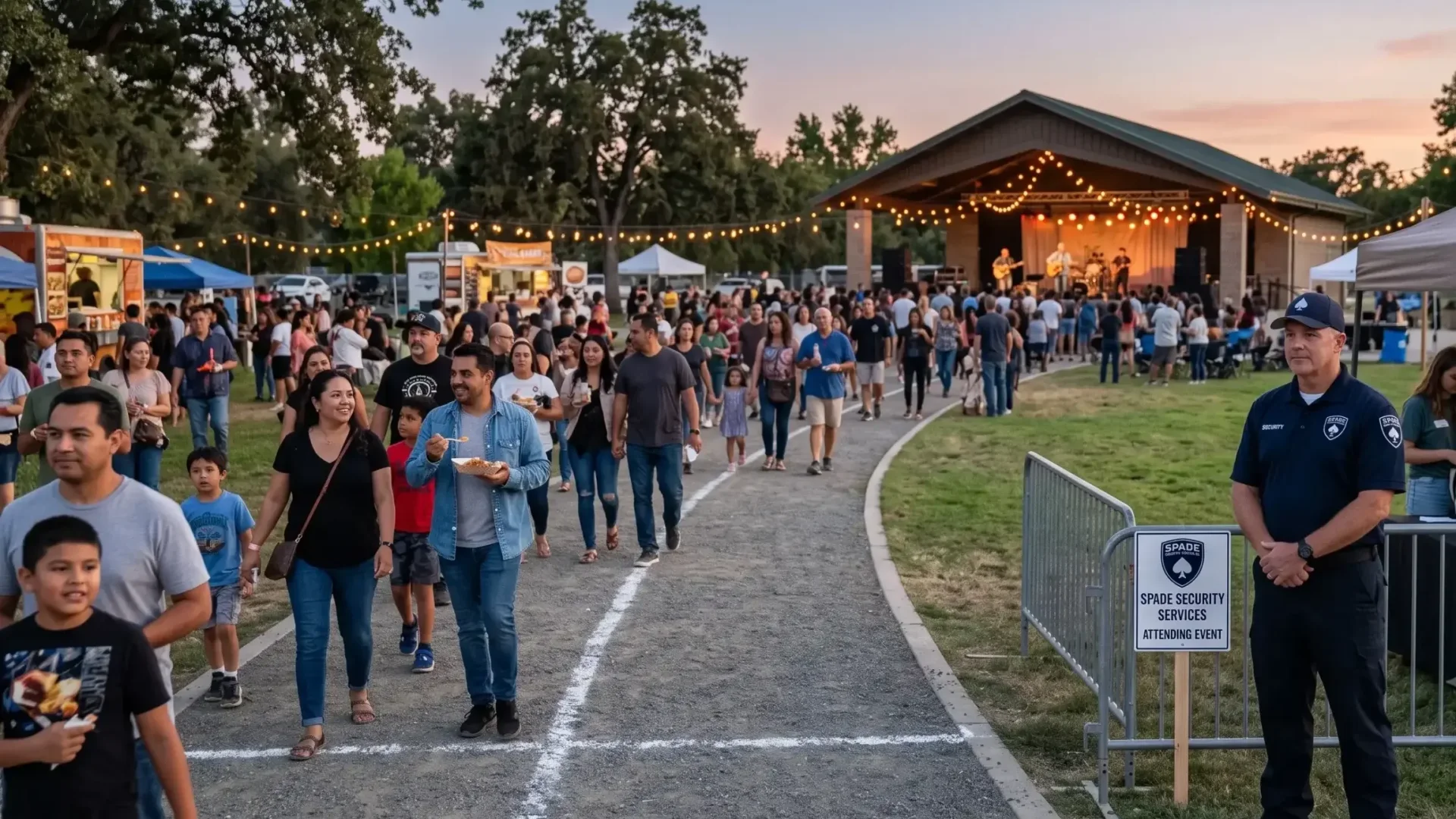
A Packed Venue Is Not a Security Plan — It’s the Reason You Need One
Large gatherings have always carried risk, but the scale of that risk is shifting faster than most venue operators and event organizers have adjusted for. The U.S. crowd management and event security market is projected to grow from $368.5 million in 2024 to $3.52 billion by 2037 — a signal that the industry itself recognizes how much more exposure large gatherings now carry, and how much less optional professional security coverage has become.
For venue owners, HOA event coordinators, corporate campuses hosting large functions, and organizers of community gatherings across the Sacramento region, the question is no longer whether an event needs security. It’s whether the security plan actually matches the specific risks a crowd of that size, in that location, creates.
Why Crowd Density Changes Everything About Risk
The most common event security incidents are not the dramatic ones that make headlines. Crowd surges at entry points, stages, and exits remain one of the most dangerous and frequent risks at any large gathering — and they escalate quickly in venues that were not designed with real-time crowd flow monitoring in mind. Alcohol service adds another layer entirely: events serving alcohol see significantly higher rates of altercations, disorderly conduct, and medical incidents than dry events of comparable size.
None of these risks require a targeted attack to become serious. A single blocked exit, an unmonitored access point, or a delayed response to an altercation can escalate into an incident that draws liability exposure regardless of whether anything was ever intentional.
Why Liability Exposure for Organizers Has Increased
High-profile crowd safety incidents in recent years have measurably increased the legal exposure organizers face, turning professional event security from a nice-to-have into a documented risk management necessity. If an incident occurs at an event and the organizer cannot demonstrate a reasonable, proportional security plan was in place, that absence becomes part of the record in any resulting claim — the same foreseeability standard that applies to premises liability in general now extends directly to event planning.
Why a Generic Security Plan Fails Most Events
A security plan built for a 200-person corporate function does not scale to a 5,000-person community festival, and a plan built for an indoor venue with controlled access points does not translate to an outdoor gathering with open perimeters. Yet many organizers default to whatever security arrangement was used for the last event, regardless of how different the venue, crowd size, or risk profile actually is.
SPADE builds event security programs around the specific event — access control at defined entry points, uniformed officer presence positioned at the actual risk zones of a venue rather than spread evenly regardless of where incidents are most likely, coordination with venue staff on crowd flow during peak arrival and departure windows, and a direct communication protocol with local law enforcement before the event begins, not after something has already gone wrong.
What Effective Event Security Actually Requires
Every SPADE event security engagement starts with an assessment of the venue itself — sightlines, choke points, alcohol service areas, parking and transit access, and the realistic size and behavior of the expected crowd. From there, coverage is built specifically for that event: officers positioned at access points and known risk zones, mobile patrol across parking and perimeter areas, and documented incident reporting that protects the organizer if any question about the event’s security ever comes up afterward.
Every officer on a SPADE event contract is directly employed and managed — never subcontracted from a staffing pool assembled for the occasion — which is what allows the same standard of training and response consistency at a 300-person gathering as at a 5,000-person event.
What This Means for Organizers Planning Their Next Event
The event security market is growing because the risks organizers face are growing with it — not because security has become a trend. A well-attended event is not, on its own, evidence of good planning. It’s the exact condition under which a security gap becomes visible fastest, and the exact reason a proportional, venue-specific security plan needs to be in place before the doors open.
Schedule a Free Event Security Assessment
SPADE Security Services | Rocklin, CA | Veteran-owned | DVBE certified
Serving Placer, Sacramento, and El Dorado counties
Licensed by the California Bureau of Security and Investigative Services
PPO121804
What are the most common security risks at large events?
Crowd surges at entry points, stages, and exits are among the most frequent and dangerous risks at large gatherings. Alcohol-related altercations and medical incidents are significantly more common at events serving alcohol. Most incidents are not premeditated attacks — they emerge from crowd density, blocked access points, and delayed response to escalating situations.
Why has liability exposure for event organizers increased?
High-profile crowd safety incidents have raised the legal standard organizers are held to. If an incident occurs and the organizer cannot demonstrate a reasonable, proportional security plan was in place beforehand, that absence becomes part of the record in any resulting liability claim.
Does every event need the same level of security coverage?
No. Security needs depend on expected attendance, venue layout, whether alcohol is served, access point configuration, and the specific risk profile of the event. A plan built for one event size or venue type does not automatically scale to a different one.
What should an event security plan include?
An effective plan includes access control at defined entry points, officer presence positioned at the venue’s actual risk zones, mobile patrol across parking and perimeter areas, coordination with venue staff on crowd flow during peak periods, and a direct communication protocol with local law enforcement established before the event begins.
Does SPADE provide event security for venues and community gatherings in the Sacramento region?
Yes. SPADE builds venue-specific event security programs for corporate functions, community festivals, HOA events, and venues of varying sizes across Placer, Sacramento, and El Dorado counties. Every officer is directly employed and managed by SPADE — no subcontracting — supporting consistent training and response quality regardless of event size.
SPADE Security Services | Rocklin, CA | Veteran-owned | DVBE certified | Serving Placer, Sacramento & El Dorado counties
Licensed by the California Bureau of Security and Investigative Services
Menu

