
- Industries
- Commercial Property ManagementParking lots, lobbies and common areas protected day and night.
- ConstructionJob site theft and after-hours break-ins, covered until the crew returns.
- Logistics and WarehouseGates, yards and loaded trailers watched and logged around the clock.
- AutomotiveLots, keys and inventory protected while the dealership is closed.
- EducationCampuses, doors and after-hours events kept safe.
- Health Care FacilityVisitor screening, patrols and monitoring for healthcare buildings.
- Services
- Security Guards & PatrolLicensed officers at the gate or on mobile patrol, with GPS-verified logs.
- Drone & RoboticsAerial and robotic patrols for large or hard-to-reach sites.
- Security TrailersMobile surveillance units that can be deployed within hours.
- Security CamerasCamera systems built to detect and report, not just record.
- Video MonitoringAI flags it, a human verifies it, and dispatch follows. 24/7.
- NotaryNotary public services for your business.
- Live ScanLive Scan fingerprinting for background checks.
- Resources
- About us
- Careers
What Every Sacramento Landlord Gets Wrong About Security — And What It Costs Them When a Claim Is Filed
Author
Pranil Shankar
Post Date
June 22, 2026
Views
298
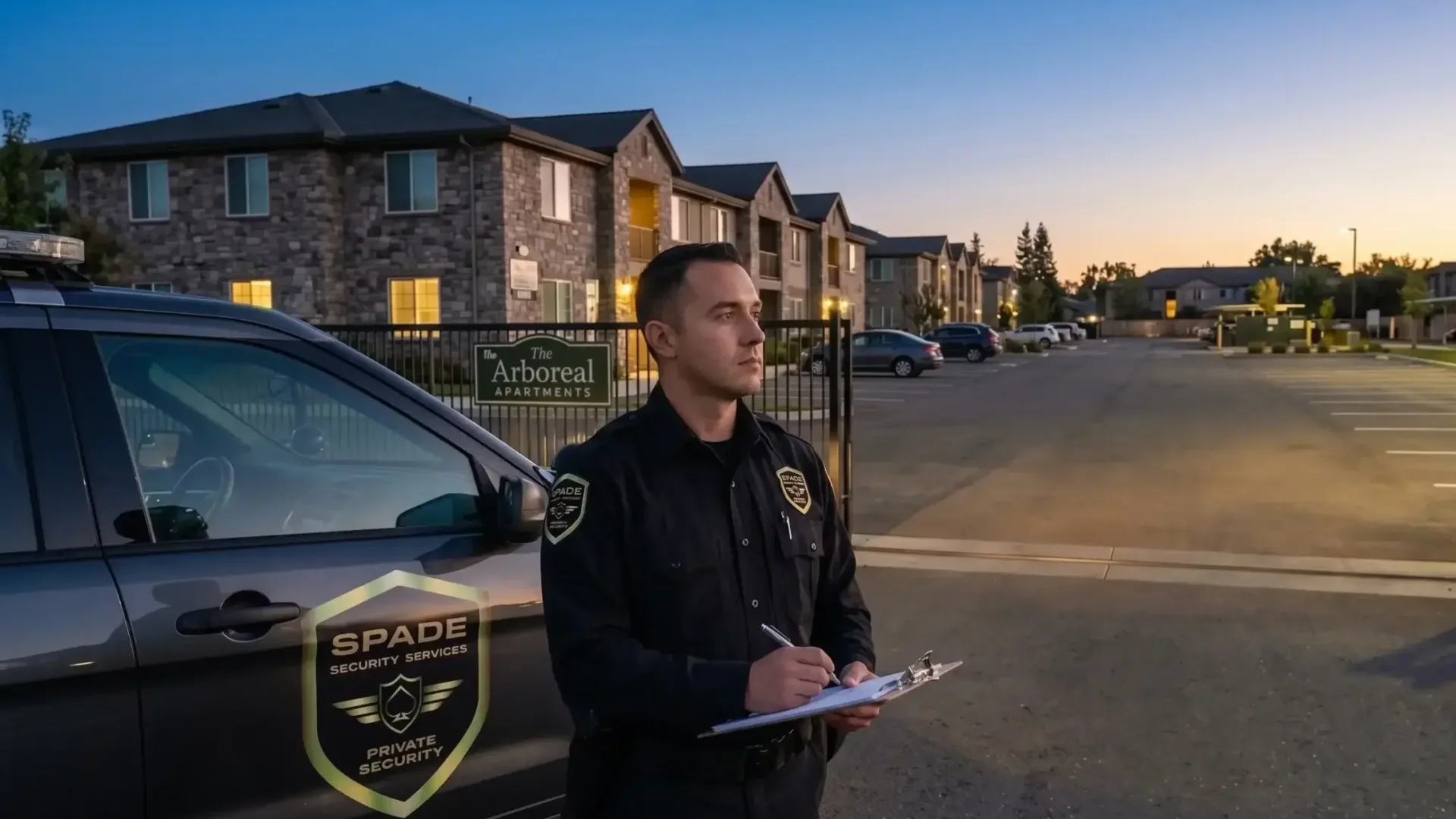
The Security Mistake Sacramento Landlords Make — And What It Costs When a Claim Is Filed
Most landlords in Sacramento think about security the same way they think about fire extinguishers — something that needs to exist, something that gets checked off a list, and something that rarely gets thought about again until something goes wrong. The problem is that when something does go wrong on your property — an assault in the parking lot, a break-in at a tenant’s unit, a robbery in a poorly lit corridor — the first question an attorney or insurance adjuster is going to ask is not “did you have security?” The question is: “What did you know, when did you know it, and what did you do about it?”
That question is called the foreseeability standard — and it is the legal framework that determines whether a property owner is liable when a crime occurs on their premises. In Sacramento County, where property crime rates in certain corridors — particularly around Stockton Boulevard, Florin Road, and parts of North Highlands — remain persistently elevated, that standard is not difficult to meet.
Here is what most Sacramento landlords get wrong — and what it ends up costing them.
The Foreseeability Trap: Why “We Had Cameras” Is Not Enough
Cameras are the most common security measure landlords point to when a claim is filed. The assumption is that visible surveillance equipment signals due diligence. But cameras alone do not prevent crime — they record it. And in a liability claim, a recording of an assault that happened because no one was monitoring the feed, no one responded in time, and no one documented prior incidents in the area can actually work against you.
What insurance carriers and plaintiff attorneys look for is not the presence of equipment. They look for a documented security program — one that shows you assessed the risk, implemented a proportional response, and maintained records proving that response was ongoing. A camera that hasn’t been checked in three months and a parking lot light that burned out six weeks before an incident are not evidence of due diligence. They are evidence of neglect.
SPADE Security Services works directly with property managers across Placer, Sacramento, and El Dorado counties to build security programs that hold up — not just operationally, but on paper. Every patrol is logged. Every incident is documented. Every observation that informs a security recommendation gets recorded in writing. That paper trail is not administrative overhead. It is your legal protection.
What Sacramento Landlords Are Actually Facing on the Ground
The security risks facing residential and commercial landlords in the Sacramento region are not abstract. They are specific, recurring, and in many cases preventable with the right program in place:
- Unauthorized encampments on vacant lots and in peripheral areas of multi-unit properties, particularly in South Sacramento and the unincorporated areas of Sacramento County
- Vehicle break-ins and catalytic converter theft in surface parking lots, which have spiked across the greater Sacramento area and generate both direct losses and tenant attrition
- Package theft and mail fraud in common entry areas of apartment complexes, which tenants increasingly hold landlords responsible for
- Trespassing and after-hours loitering around laundry facilities, pool areas, and secondary entrances — spaces that are difficult to monitor with static cameras alone
- Domestic incidents spilling into common areas, which create liability exposure for landlords who were aware of prior disturbances and failed to act
Each of these scenarios has one thing in common: they are foreseeable. Crime data, police reports, tenant complaints, and even neighborhood watch posts create a documented record of what was known and when. If that information was available to you and you did not respond to it, the foreseeability argument becomes straightforward for any attorney pursuing a premises liability claim.
The Documentation Gap That Turns an Incident Into a Lawsuit
One of the most costly mistakes Sacramento landlords make is failing to maintain a security log that runs parallel to their incident records. This is different from a maintenance log or a tenant complaint file. A security log documents:
- What areas were patrolled, at what times, and by whom
- What conditions were observed — lighting status, gate function, access point integrity
- What incidents or near-incidents were noted and how they were escalated
- What follow-up actions were taken and when
When a claim is filed and this log does not exist, you are left arguing from memory against an opposing attorney who has a timeline built from police reports, tenant texts, and whatever footage your cameras happened to capture. That is not a favorable position.
SPADE Security Services generates detailed patrol reports for every engagement. Property managers receive documentation they can actually use — in conversations with their insurance carrier, in response to tenant concerns, and in their own records if a claim is ever filed. This is not a feature. It is a baseline requirement of any professional security program.
Why Subcontracting Creates Liability You Did Not Agree To
Many security companies operating in the Sacramento market use subcontracted labor — officers who are technically employed by a third-party staffing firm, not the security company you signed a contract with. This matters for one very specific reason: when an incident occurs and your contract is scrutinized, the chain of accountability becomes murky. Who trained that officer? Who supervised them? Who verified their license status on the date of the incident?
SPADE does not subcontract. Every officer who serves a SPADE client is hired, trained, background-checked, and managed directly by SPADE. That means when documentation is produced, it reflects a real chain of command — not a layered arrangement designed to diffuse accountability. For landlords thinking about how a security program will look in the context of a claim, that distinction matters significantly.
What a Proportional Security Response Actually Looks Like
There is no single security formula that applies to every Sacramento rental property. A 12-unit apartment complex in Roseville has different exposure than a 200-unit mixed-income community near Florin Road. A commercial strip center in Elk Grove faces different risks than an industrial park off Interstate 80 in Rocklin. Proportional response means your security program is calibrated to your actual risk profile — not a generic contract that looks the same for every property the vendor serves.
For residential landlords, a proportional program typically includes some combination of:
- Scheduled and randomized mobile patrol during overnight and early morning hours
- Static posts during high-traffic periods such as move-in weekends, rent collection days, and holiday periods
- Remote video monitoring integration for properties with existing camera infrastructure
- Written incident response protocols so your on-site team knows exactly what to do and who to call when something happens
The goal is not to eliminate crime — no security program can guarantee that. The goal is to demonstrate, through consistent documented action, that you took reasonable steps to protect your tenants and your property. That demonstration is what separates a defensible position from an indefensible one when a claim is filed.
The Insurance Conversation Most Landlords Avoid
Property and casualty insurance carriers in California are paying close attention to premises liability claims involving security negligence. Some carriers are now asking specific questions during renewal about whether properties in higher-risk zip codes have active security programs — and whether documentation of those programs is available. A well-structured security contract with a licensed, veteran-owned provider like SPADE can become part of the conversation you have with your broker about your risk profile.
That conversation is worth having before a claim forces it. A proactive security investment that reduces your exposure and supports a stronger documentation record can influence how your carrier assesses your property — and what they charge you for coverage.
If you manage rental property in the Sacramento region and you are not confident your current security program would hold up in a liability review, the time to fix that is before a claim is filed — not after.
Schedule a Property Security Review
SPADE Security Services | Rocklin, CA | Veteran-owned | DVBE certified
Serving Placer, Sacramento, and El Dorado counties
Licensed by the California Bureau of Security and Investigative Services
PPO121804
What is the foreseeability standard and how does it apply to Sacramento landlords?
The foreseeability standard is a legal principle used in premises liability cases to determine whether a property owner should have anticipated a risk of harm and taken steps to prevent it. In Sacramento, this means that if crime data, tenant complaints, police reports, or prior incidents gave a landlord reason to believe their property was at risk, they may be held liable if they failed to implement a reasonable security response. Courts look at what the landlord knew or should have known — and whether their actions matched that knowledge. A documented security program with patrol logs and incident records is the most reliable way to demonstrate reasonable care.
Do security cameras satisfy a landlord’s duty of care in California?
Not on their own. Cameras are one component of a security program, but California courts evaluating premises liability claims look at the totality of the security measures in place — not just whether equipment exists. A camera that is not monitored, not maintained, or not integrated with a documented response protocol offers limited legal protection. What matters is whether the landlord implemented a proportional, ongoing, and documented security program relative to the known risks at the property.
What security documentation should Sacramento property managers maintain?
At minimum, property managers should maintain a security log that records patrol activity, observation reports, access point conditions, lighting status, and any incidents or near-incidents — along with the follow-up actions taken. This documentation should be generated by your security provider after every engagement and retained as part of your property records. In addition to supporting a liability defense, this documentation is increasingly relevant in conversations with insurance carriers during policy renewal, particularly for properties in higher-risk areas of Sacramento County.
Why does subcontracting matter when choosing a security company for my rental property?
When a security company uses subcontracted labor, the chain of accountability becomes unclear — particularly around training, licensing verification, and supervision. If an incident occurs and your security contract is reviewed as part of a claim, gaps in that chain can create additional liability exposure for the property owner. Working with a security company like SPADE that directly employs every officer — with no subcontracting — means you have a clear, documented accountability structure that holds up under scrutiny.
How do I know if my Sacramento rental property needs a security assessment?
If your property has experienced any of the following in the past 12 months — vehicle break-ins, trespassing, unauthorized encampments, tenant complaints about safety, package theft, or any incident requiring a police response — a formal security assessment is warranted. You should also consider an assessment if your property is located in a zip code with elevated property crime rates, if you are approaching an insurance renewal where security documentation may be requested, or if you have recently acquired a new property and have not yet evaluated its security baseline. Call SPADE at (888) 772-3301 to schedule.
SPADE Security Services | Rocklin, CA | Veteran-owned | DVBE certified | Serving Placer, Sacramento & El Dorado counties
Licensed by the California Bureau of Security and Investigative Services


THE ACE IN SECURITY
Menu
Stay Ahead of Security Threats
Get Spade Security’s latest insights, incident breakdowns and company news in your inbox — only when we publish.
Text size: 100%