
- Industries
- Commercial Property ManagementParking lots, lobbies and common areas protected day and night.
- ConstructionJob site theft and after-hours break-ins, covered until the crew returns.
- Logistics and WarehouseGates, yards and loaded trailers watched and logged around the clock.
- AutomotiveLots, keys and inventory protected while the dealership is closed.
- EducationCampuses, doors and after-hours events kept safe.
- Health Care FacilityVisitor screening, patrols and monitoring for healthcare buildings.
- Services
- Security Guards & PatrolLicensed officers at the gate or on mobile patrol, with GPS-verified logs.
- Drone & RoboticsAerial and robotic patrols for large or hard-to-reach sites.
- Security TrailersMobile surveillance units that can be deployed within hours.
- Security CamerasCamera systems built to detect and report, not just record.
- Video MonitoringAI flags it, a human verifies it, and dispatch follows. 24/7.
- NotaryNotary public services for your business.
- Live ScanLive Scan fingerprinting for background checks.
- Resources
- About us
- Careers
Mobile Patrol vs. Static Guard: Which Security Service Does Your Sacramento Property Actually Need
Author
Pranil Shankar
Post Date
June 19, 2026
Views
253
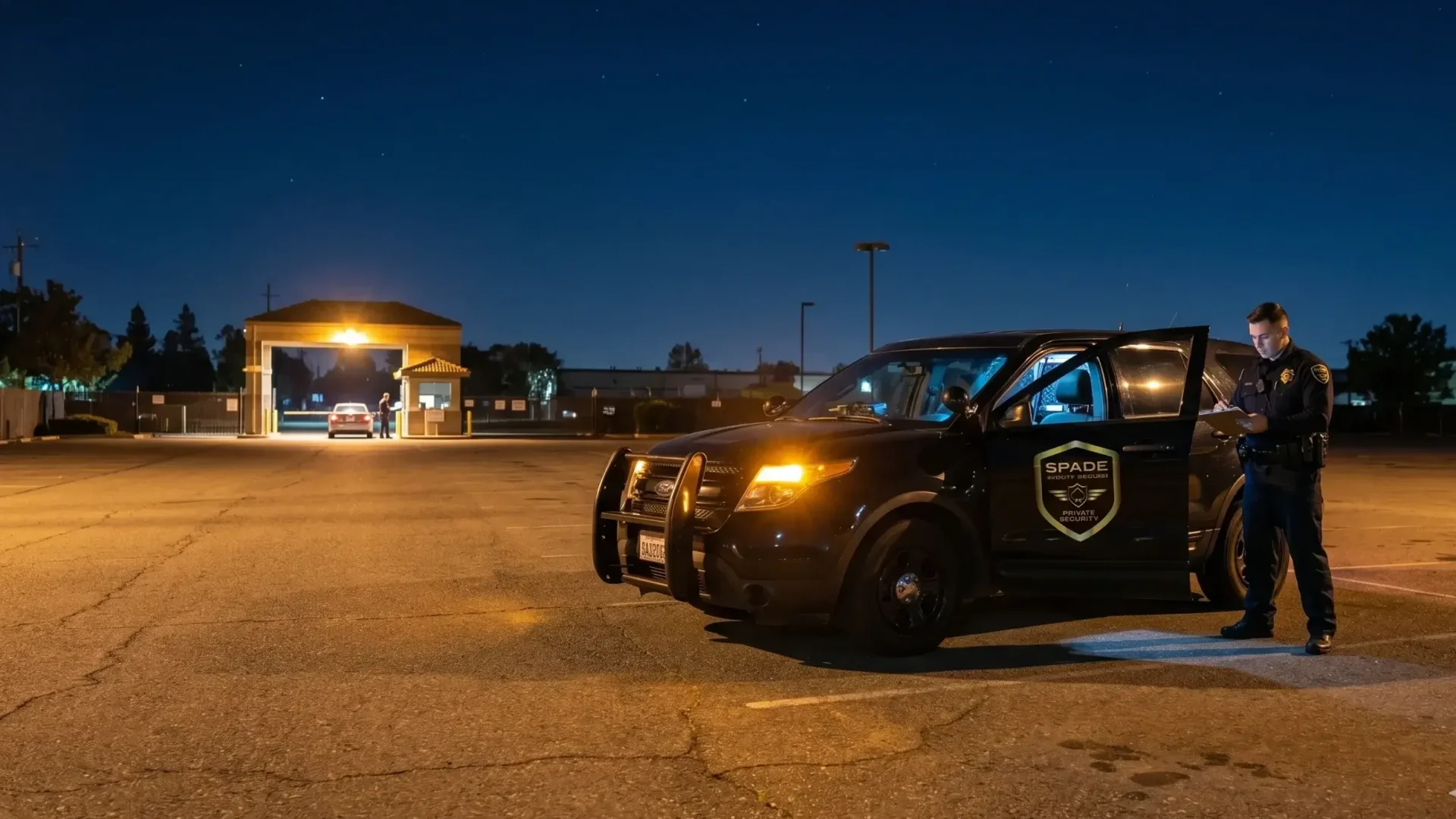
Most Sacramento Businesses Pick the Wrong Security Service — Not Because They Made a Bad Decision, But Because Nobody Explained the Difference
Most Sacramento businesses that are evaluating security for the first time reach the same fork in the road early in the conversation: do we need a guard who stays in one place, or a guard who moves?
It sounds like a simple logistics question. It is actually a strategic question about what security outcomes you are trying to produce, what your property’s specific risk profile looks like, and where your budget is most effectively deployed.
The answer is different for a 30-unit apartment complex in Elk Grove than it is for a car dealership lot in Roseville. Different for a construction site in Rocklin than for a shopping center in Rancho Cordova. And the security companies that tell you one approach is universally better are telling you something about what they sell — not about what your situation requires.
This post is a direct, useful explanation of what mobile patrol and static guard services actually do, where each approach produces the best outcomes for Sacramento businesses, and how to make a clear decision based on your specific situation rather than a vendor recommendation.
What Is Mobile Patrol and How Does It Work in Sacramento?
Mobile patrol is a security service where licensed officers patrol a defined area — a property, a group of properties, or a geographic route — in a marked patrol vehicle, on foot, or in combination. Patrol officers conduct inspections of the assigned area on a schedule that combines pre-set visits with randomized timing, and document each visit with a patrol log that records time of arrival, observations, and any incidents encountered.
For Sacramento businesses, mobile patrol typically operates in one of two configurations.
Dedicated patrol assigns a patrol officer exclusively to one client’s property during the contracted service period. The officer’s entire shift is spent on that property — driving or walking the perimeter, checking access points, monitoring parking areas, and responding to any activity or incident that requires attention. Dedicated patrol provides more coverage per hour than shared patrol and is the right approach for larger properties or higher-risk environments where continuous presence within a single location is required.
Shared route patrol assigns a patrol officer to a defined geographic area with multiple client stops. The officer visits each client property on the route according to a schedule — typically multiple visits per shift — and conducts a patrol check at each stop before moving to the next. Shared patrol is significantly more cost-effective than dedicated patrol and is appropriate for smaller properties, lower-risk environments, or situations where the primary security goal is deterrence through unpredictable presence rather than continuous on-site coverage.
What Is a Static Security Guard and When Is It the Right Approach?
A static security guard is a licensed officer assigned to a fixed position — an entry point, a lobby, a gate, a specific area within a facility — for the duration of their shift. The static officer does not patrol the broader property. Their coverage area is defined by the position they are assigned to and the sightlines from that position.
Static guard coverage is the right approach when the primary security requirement is a function that cannot be performed by a patrol vehicle making periodic visits.
- Access control at an active entry point requires a static presence. A gate guard who verifies credentials, checks documentation, controls vehicle and pedestrian access, and makes real-time decisions about who enters a facility cannot perform those functions from a moving patrol vehicle. The access control function requires a person who is at the gate, continuously, during the access-controlled period.
- De-escalation in a high-activity environment requires a static presence. A lobby security officer who manages the behavioral environment of a commercial building, a hospital waiting room, or a retail store floor must be present in that space continuously to observe, assess, and intervene before situations escalate. A patrol officer who visits every 30 minutes cannot perform this function.
- High-value asset protection during the period of maximum risk often requires static coverage. A dealership lot during a holiday weekend, a construction site during the highest-risk overnight period, or a distribution yard during the Friday-through-Monday window may require continuous on-site presence rather than periodic patrol visits.
When Does Mobile Patrol Outperform Static Guard Coverage for Sacramento Properties?
Mobile patrol outperforms static guard coverage in specific situations where the primary security requirement is broad-area deterrence, perimeter coverage, or multi-site monitoring rather than continuous presence at a fixed point.
- Large footprint properties with multiple access points. A distribution facility with a multi-acre yard, a construction site spanning a full city block, or an apartment complex with parking on multiple sides of the building requires coverage across a physical area that a static guard at a single post cannot provide. Mobile patrol covers the full perimeter and multiple access points in a way that one static post cannot replicate.
- Multiple properties requiring consistent overnight coverage. A property management company with five commercial properties across Sacramento County cannot staff static guards at each location every night without a budget that rarely exists for that purpose. Mobile patrol covering all five properties from a shared route provides consistent coverage, documented visit logs, and meaningful deterrence across the portfolio at a fraction of the cost of five separate static contracts.
- Properties where unpredictable timing is the primary deterrent mechanism. Organized theft operations and trespassing activity is deterred most effectively by unpredictability. A static guard is at a known position at all times — an organized operation can plan around a predictable post. A mobile patrol with randomized visit timing cannot be reliably anticipated, which is precisely what makes it an effective deterrent for the criminal activity that responds most to uncertainty.
How Do I Choose Between Mobile Patrol and Static Guard for My Sacramento Property?
Three questions clarify the decision for most Sacramento businesses.
First: does your security requirement involve a function that requires continuous physical presence at a specific point — access control, lobby management, active crowd behavior management? If yes, a static guard at that point is the right tool for that function.
Second: does your security requirement involve covering a large area, creating deterrence through unpredictable presence, or managing multiple properties with consistent documentation? If yes, mobile patrol is likely the primary tool.
Third: are there elements of both? Most commercial properties in Sacramento have both a fixed-point requirement — a primary entry that needs controlled access — and a broader area requirement — a parking lot or perimeter that needs patrol coverage. The integrated approach, combining a static post for the access control function with mobile patrol for the broader coverage requirement, is the solution that most mid-size properties in the Sacramento region implement once they understand the distinction clearly.
Why Sacramento Businesses Choose SPADE Security Services
SPADE Security Services is a veteran-owned, DVBE-certified physical security company headquartered in Rocklin, California. We provide both mobile patrol and static guard services — and, more importantly, we help clients understand which approach their specific situation requires rather than recommending based on what generates the higher contract value.
Our mobile patrol operation covers properties across Sacramento County, Placer County, and El Dorado County. Our static guard programs serve commercial, industrial, retail, and property management clients with coverage designed around their specific access control, deterrence, and documentation requirements.
We offer complimentary security assessments for all client types. We walk your property, assess your risk profile, and give you a clear, direct recommendation — static, patrol, or integrated — with the reasoning behind it in writing.
SPADE Security Services | Rocklin, CA | Veteran-owned | DVBE certified
Serving Placer, Sacramento, and El Dorado counties
Licensed by the California Bureau of Security and Investigative Services
PPO121804
Get Your Free Security Assessment
Frequently Asked Questions
What is the cost difference between mobile patrol and a static security guard in Sacramento?
Mobile patrol on a shared route is typically significantly less expensive per coverage hour than dedicated static guard staffing. The cost difference reflects the difference in coverage model: a shared route patrol officer distributes their shift across multiple client properties, while a static guard’s entire shift is dedicated to a single post. For properties where the primary security goal is deterrence through visible presence and documented patrol, shared mobile patrol often delivers comparable outcomes to a static post at a fraction of the cost. For properties where continuous presence at a specific point is required, static coverage is not substitutable regardless of cost comparison.
How often does a mobile patrol visit my Sacramento property during a shift?
Visit frequency for mobile patrol in Sacramento depends on the service agreement and the client’s specific coverage requirements. A standard shared patrol agreement typically includes between two and five visits per shift per property. A dedicated patrol agreement covering a single property provides continuous coverage for the shift duration. Visit timing is structured to include both scheduled visits and randomized visits that eliminate predictable gaps — randomization is the element that makes mobile patrol an effective deterrent against organized criminal activity that surveils targets before acting.
Do mobile patrol officers in Sacramento generate documentation the same way static guards do?
Yes. Professional mobile patrol officers generate patrol logs documenting each visit — time of arrival, observations made during the patrol check, any incidents encountered, and time of departure. The documentation format for patrol logs is equivalent in evidential value to the incident reports generated by static guard positions. For insurance carriers, property owners, and HOA boards that require documented security activity, patrol logs from a licensed security company meet the documentation standard. SPADE patrol logs are formatted specifically to support insurance carrier documentation requirements and HOA board reporting.
Can mobile patrol respond to an incident at my Sacramento property outside of scheduled visit hours?
A security company with its own patrol fleet and dispatch capability can deploy a patrol officer to a client property for an incident response outside of the scheduled visit schedule. This capability — dispatch response — is distinct from the scheduled patrol service and depends on whether the security company has available patrol resources in your area at the time of the call. SPADE maintains dispatch capability for client properties across Sacramento County and Placer County during active patrol hours — contact us to discuss the specific dispatch response commitment available for your property.
Is mobile patrol or static guard coverage more appropriate for a Placer County HOA community?
For most HOA communities in Placer County — including residential communities in Rocklin, Roseville, and El Dorado Hills — mobile patrol with randomized visits is the primary coverage model, supplemented by static coverage at gated pedestrian entry points during the highest-risk evening hours for communities with documented access control problems. The patrol model provides perimeter and street coverage across the community that a single static post cannot replicate, while static coverage at an entry point closes the access control gap that automated gates leave open. SPADE designs HOA security programs around each community’s specific CC&R enforcement requirements and incident history.
SPADE Security Services | Rocklin, CA | Veteran-owned | DVBE certified | Serving Placer, Sacramento & El Dorado counties
Licensed by the California Bureau of Security and Investigative Services


THE ACE IN SECURITY
Menu
Stay Ahead of Security Threats
Get Spade Security’s latest insights, incident breakdowns and company news in your inbox — only when we publish.
Text size: 100%