
How Cargo Theft Is Costing Sacramento Warehouses in 2026 — And What You Can Do About It
Author
Pranil Shankar
Post Date
May 11, 2026
Views
126
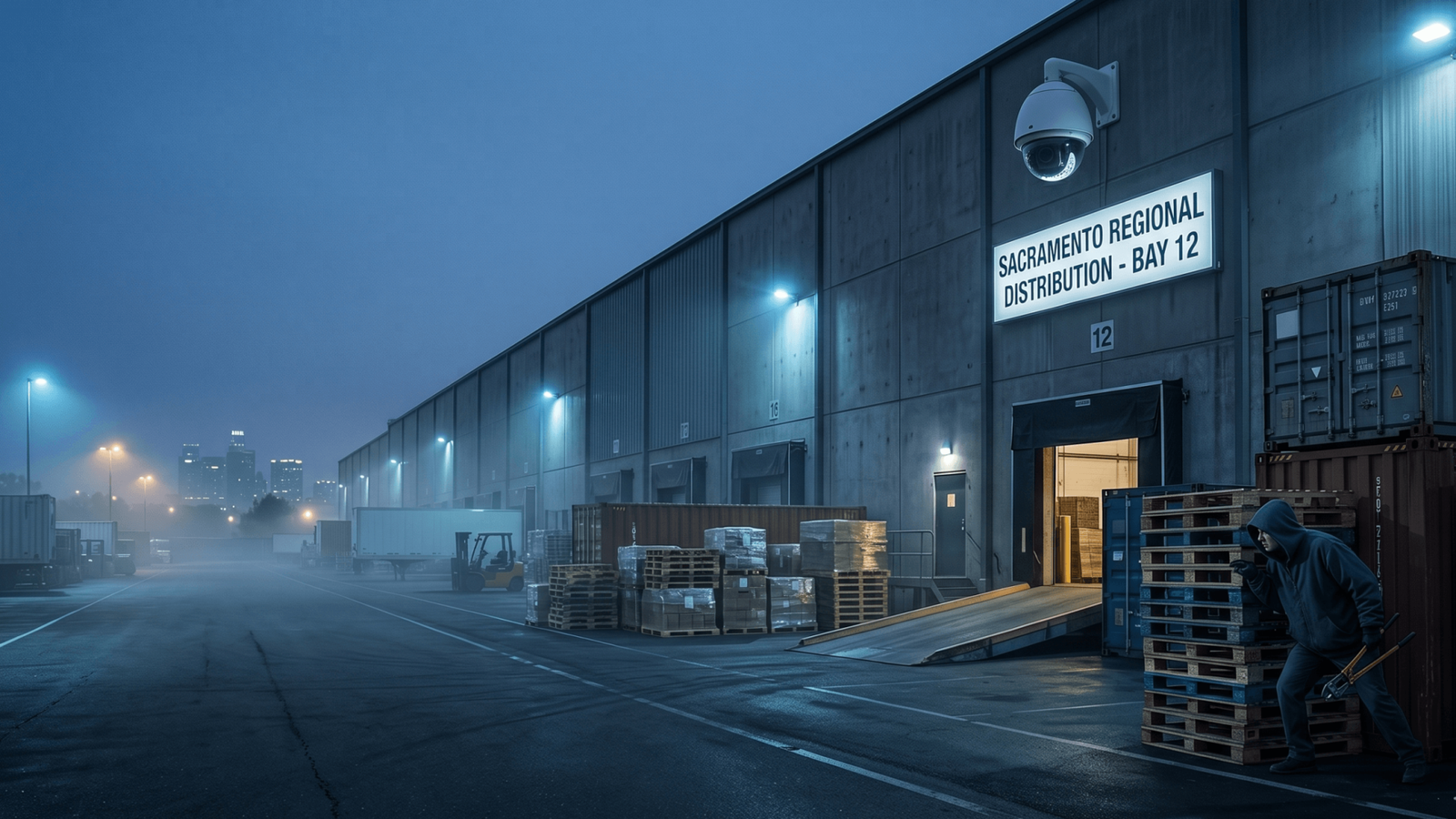
Thieves today are not opportunistic. They surveil facilities in advance, identify shift-change windows when guard coverage is thinnest, and target trailers staged in unsecured yards during off-hours. Straight truck theft, container manipulation, and fictitious pickups using fraudulent documentation have all increased year over year.
For the operations manager or risk director, the exposure goes beyond the stolen goods. A single cargo theft incident can trigger insurance claims reviews, customer contract penalties, and regulatory scrutiny — all of which land on your desk.
What does a cargo theft incident actually cost a Sacramento logistics facility?
The visible cost is the inventory value. The invisible costs are what keep risk managers up at night.
A mid-size distribution center in the Elk Grove or Rancho Cordova area faces the following when a theft occurs:
- Direct inventory loss — often not fully covered if security protocols weren’t in place
- Customer contract penalties — missed SLAs and delayed shipments trigger financial consequences
- Insurance premium increases — a single claim can raise annual premiums for years
- Internal investigation time — operations leadership hours diverted from revenue-generating work
- Reputational damage — enterprise clients expect documented security protocols before awarding contracts
Industry estimates place the true cost of a cargo theft incident at three to five times the value of the stolen goods when downstream consequences are factored in. For a Sacramento-area logistics operation, that math demands a serious look at security investment.
What security measures work best for Sacramento-area logistics facilities?
Logistics facilities have different security requirements than retail or office environments. The right security approach depends on your facility’s size, operating hours, and inventory profile — but the following measures are consistently effective for warehouse and distribution operations in the Sacramento region.
Mobile patrol with scheduled and random rotations. A predictable patrol schedule is better than nothing, but a randomized element is what actually deters organized theft rings. Mobile patrol units that vary their timing and routes eliminate the surveillance advantage thieves rely on.
After-hours static guard coverage at staging areas. Trailer yards and loading docks during non-operating hours are the highest-risk windows for most facilities. A static guard presence at access points during these periods closes the most common vulnerability.
Remote video monitoring with live response. AI-assisted surveillance systems that flag anomalous movement and connect to a live monitoring center allow for immediate response without requiring full on-site staffing around the clock. This is particularly cost-effective for larger footprint facilities in Elk Grove and Rancho Cordova where perimeter coverage across multiple acres is required.
Access control at shift change. Theft by employees or contractors is statistically significant in logistics environments. Documented access protocols and guard presence during shift transitions reduce both opportunity and liability.
How do I choose a security company for my Sacramento logistics facility?
The right security provider for a logistics operation is not a generalist. Look for a company with direct experience securing warehouse and distribution environments, not just retail or residential properties.
Key questions to ask any security company before signing a contract:
- Do your guards have experience with logistics-specific protocols, including trailer yard procedures and access documentation?
- Can you provide mobile patrol with randomized scheduling, not just fixed-time visits?
- Do you offer remote video monitoring integration, or are you guard-only?
- Are your guards licensed through the California Bureau of Security and Investigative Services (BSIS)?
- What is your incident reporting process, and how quickly does documentation reach facility management?
A security company that can answer all five clearly, with specific examples from logistics environments, is one worth talking to further.
Why Sacramento logistics managers choose SPADE Security Services
SPADE Security Services is a veteran-owned, DVBE-certified physical security company headquartered in Rocklin, California. We serve logistics, warehouse, and distribution facilities across Sacramento County, Placer County, and El Dorado County.
Our guards are trained in logistics-specific security protocols. Our mobile patrol operations cover facilities in Elk Grove, Rancho Cordova, and the greater Sacramento region with both scheduled and randomized rotations. We also offer AI-assisted remote video monitoring for facilities requiring perimeter coverage beyond what on-site staffing alone can provide.
We work directly with operations managers and risk directors who understand that a security failure is not just a cost — it is a liability that carries their name.
If you manage a logistics or distribution facility in the Sacramento region, we offer a complimentary security assessment with no obligation. We walk your facility, identify your highest-risk windows, and give you a clear picture of what protection looks like for your specific operation.
Contact SPADE Security Services to schedule your assessment: spadesecurityservices.com | Rocklin, CA | Serving Placer, Sacramento, and El Dorado counties.
Frequently asked questions: logistics security in Sacramento
What is the most common type of cargo theft at Sacramento warehouses?
Trailer theft during off-hours is the most frequent incident type for Sacramento-area distribution facilities. Organized theft rings target staging yards between shifts, particularly on weekends and holidays when on-site staffing is lowest. Mobile patrol coverage during these windows is the most effective deterrent.
Does my insurance require a security plan for my Sacramento warehouse?
Many commercial cargo and property insurance policies increasingly require documented security protocols as a condition of coverage or as a factor in premium calculation. A formal security assessment from a licensed provider can support your insurance documentation and potentially reduce your exposure during a claim review.
How much does security for a Sacramento logistics facility cost?
Security costs for logistics facilities in the Sacramento area vary based on facility size, required coverage hours, and service type. Mobile patrol services typically start lower than static guard contracts. SPADE Security Services provides customized pricing based on a site assessment — contact us for a no-obligation quote specific to your facility.
What is the difference between mobile patrol and a static security guard for a warehouse?
A static guard is positioned at a fixed point — typically a gatehouse or entry — for the duration of their shift. Mobile patrol officers move through and around the facility on a route, covering more ground and providing perimeter visibility that a static post cannot. Most logistics facilities benefit from a combination: static coverage at primary access points and mobile patrol across the yard and loading areas.
Is SPADE Security Services licensed to operate in Sacramento and Placer County?
Yes. SPADE Security Services is fully licensed through the California Bureau of Security and Investigative Services (BSIS) and operates across Sacramento County, Placer County, and El Dorado County. As a DVBE-certified, veteran-owned company, we are also eligible for state and local government procurement programs.
SPADE Security Services | Rocklin, CA | Veteran-owned | DVBE certified | Serving Placer, Sacramento & El Dorado counties
Licensed by the California Bureau of Security and Investigative Services
Menu

